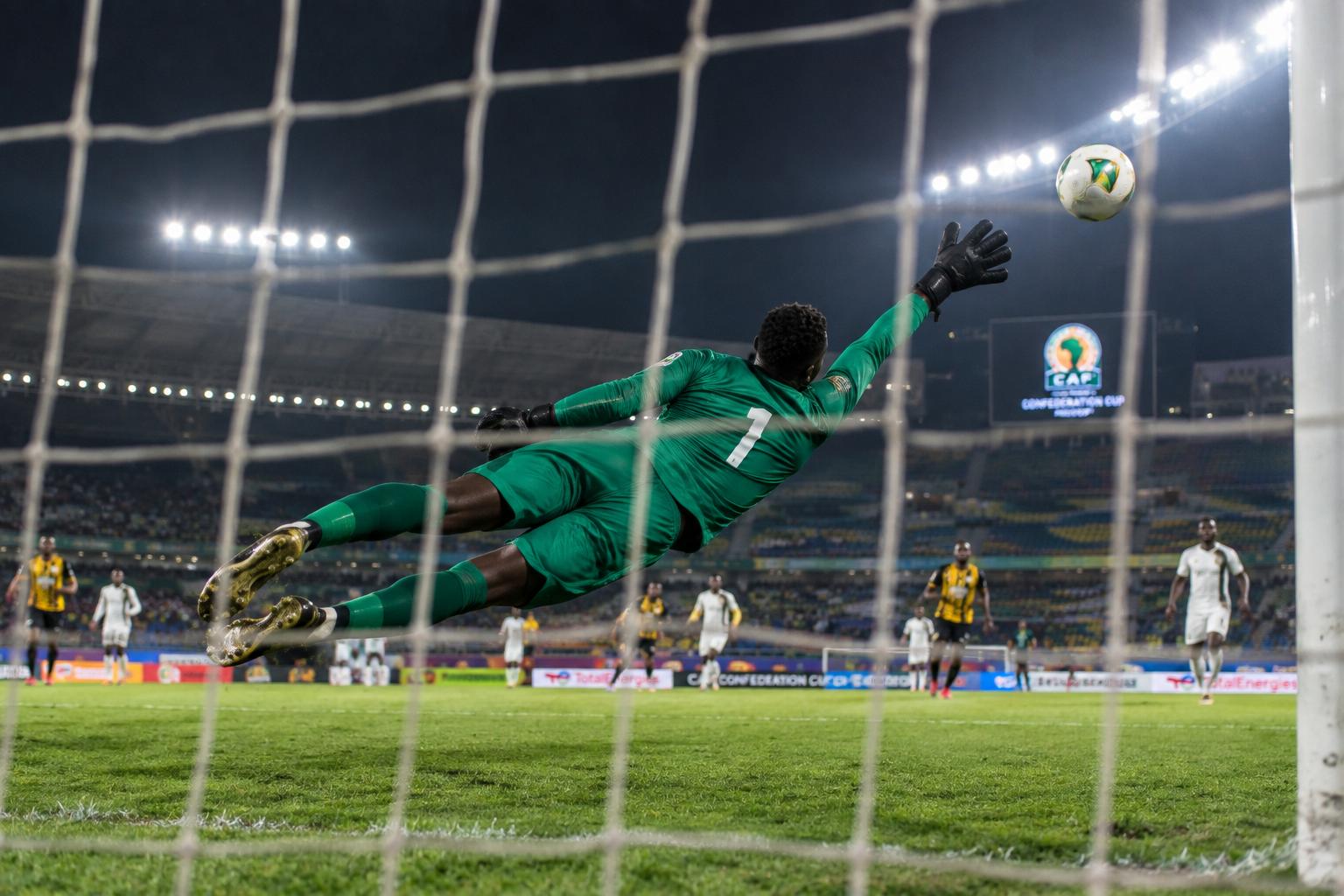
Not every club chasing continental silverware is fighting for the same trophy. Below the CAF Champions League sits a second competition with its own history, its own dominant clubs, and its own path to a final, the CAF Confederation Cup. It gets a fraction of the attention its bigger sibling does, but for a huge number of African clubs, it is the most realistic route to a continental title.
Key Takeaways
- The CAF Confederation Cup is African club football’s second-tier continental competition, ranking directly below the CAF Champions League.
- It was created in 2004 by merging two older competitions, the African Cup Winners’ Cup and the CAF Cup.
- Fifty-eight clubs enter the qualifying rounds, with the field narrowing to a 16-team group stage of four groups of four.
- RS Berkane of Morocco and CS Sfaxien of Tunisia share the record for most titles, three apiece.
- The Confederation Cup winner faces the CAF Champions League winner the following season in the CAF Super Cup.
Where the Confederation Cup Came From
The Confederation Cup is younger than it might seem given how established it now feels in the African football calendar. CAF created it in 2004 by merging two existing competitions, the African Cup Winners’ Cup, which dated back to 1975, and the CAF Cup, introduced in 1992. Folding both into a single second-tier tournament gave CAF a clearer three-tier structure across its club competitions and reduced fixture congestion for federations fielding teams in multiple continental tournaments at once.
Ghana’s Hearts of Oak won the inaugural edition, beating fellow Ghanaian side Asante Kotoko on penalties in an all-Ghanaian final that set an unusually high bar for the competition’s first year.
How the Format Works
Fifty-eight clubs enter the Confederation Cup’s qualifying rounds, earning their place based on how they finished in their domestic league or cup competition the previous season. That figure alone tells you how wide the net is cast compared with the Champions League, since it pulls in clubs from federations that might never realistically challenge for the continent’s top prize.
Qualifying is played as a knockout, with away goals used to break level ties, whittling the field down before the group stage begins. From there, the format mirrors its bigger sibling closely.
The Group Stage and Knockouts
Sixteen clubs make the group stage, split into four groups of four playing a full home-and-away round robin. The top two from each group advance into two-legged knockout rounds, quarter-finals through to a two-legged final, the same structure the Champions League uses from the same stage onward.
For a full breakdown of the Champions League’s own format, including its calendar and prize money, our companion explainer on how the CAF Champions League works covers Africa’s top club competition in detail. The two competitions run on parallel 2026-27 calendars, with group stage matches through January 2027 and finals landing in May 2027.
A Common Question: Do Champions League Clubs Ever Drop Down?
Fans new to African club football often assume clubs eliminated early from the Champions League simply parachute into the Confederation Cup, the way some European competitions work. That is not how CAF structures it. Confederation Cup entry is earned through domestic league and cup placement each season, not through failure in the bigger competition, so the two tournaments run as genuinely separate paths rather than a relegation system between them. A club’s Confederation Cup campaign is decided by how it finished at home the previous season, full stop.
What the Confederation Cup Is Worth
Winning the Confederation Cup carries real financial weight. The 2026-27 champion is set to collect USD 4 million, a meaningful jump from what it paid out in past seasons and a figure that puts serious pressure on clubs to treat the competition as more than a consolation prize next to the Champions League.
There is also a direct reward baked into the calendar beyond prize money. The Confederation Cup winner earns a place in the following season’s CAF Super Cup, a single match against the reigning Champions League winner that effectively crowns African club football’s overall season-opening curtain-raiser.
Who Has Won It the Most
Two clubs share the record for Confederation Cup titles, three apiece. RS Berkane of Morocco won in 2020, 2022, and 2025, building arguably the most consistent Confederation Cup pedigree of any club this decade. CS Sfaxien of Tunisia got there first, winning in 2007, 2008, and 2013, back when the competition was still establishing its identity separate from the Champions League.
Morocco leads all nations with eight total Confederation Cup titles spread across five different clubs, a spread that says as much about the strength of Moroccan club football generally as it does about any single dominant side.
Why the Confederation Cup Matters
It is easy to treat the Confederation Cup as a lesser prize simply because it sits below the Champions League in prestige, but that undersells what it actually represents. For federations and clubs without the financial muscle to compete at Champions League level, it is a genuinely winnable continental trophy, and clubs like RS Berkane have built real institutional strength around chasing it specifically.
With the 2026-27 season running alongside a packed year of African football, AFCON 2027 qualifying, CAF’s youth tournaments, and the Champions League all playing out on overlapping calendars, our full 2027 African football calendar rounds up everything happening across the continent in one place. And once the Confederation Cup group stage draw lands, TuSportNews will be tracking match predictions for its biggest fixtures right alongside our Champions League coverage.