When Yassine Bounou batted away Crysencio Summerville’s penalty with his left hand and Ismael Saibari stepped forward to send the decisive kick into the low left corner, it was not just the Netherlands going home. It was another chapter being written in African football’s most remarkable World Cup story.
Morocco beat the Netherlands 3-2 on penalties after a 1-1 draw through 120 minutes at Estadio BBVA in Monterrey on June 30, 2026, sending Ronald Koeman’s side out at the earliest stage of their World Cup history. Unlike Paraguay’s stunning penalty shootout win over Germany elsewhere in the Round of 32, this result was not an upset. It was, as Fox Sports concluded, the better team winning.
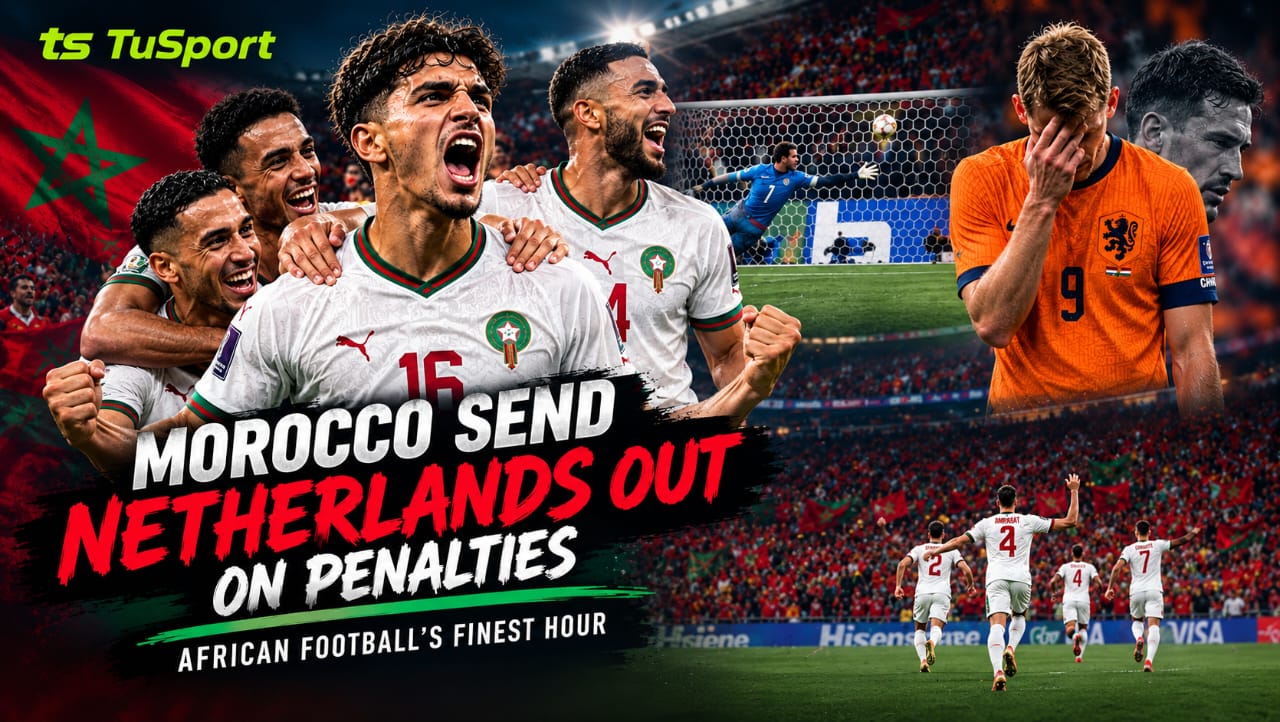
How the Match Unfolded: Morocco’s Dominance, Netherlands’ Stolen Lead
From the opening exchanges, this was not the match Ronald Koeman had planned for. He abandoned the Netherlands’ attacking 4-3-3 in favour of a five-man defensive line, conceding 70 percent possession to Morocco and inviting sustained pressure rather than seeking to exploit their own technical quality.
Morocco responded to that invitation with relish. Achraf Hakimi, the Paris Saint-Germain full-back and Morocco’s captain, was a constant threat going forward, forcing Bart Verbruggen into a pair of reflex saves in the first half, the most dangerous when Hakimi’s fierce shot from the edge of the area needed to be tipped over the bar. In the 18th minute, Hakimi’s corner found Neil El Aynaoui, whose powerful header required another brilliant save from Verbruggen.
The Netherlands’ first meaningful effort came just before half-time, when Micky van de Ven’s piledriver was tipped over by Bounou. That was the sum of their first-half attacking threat against a Morocco side that controlled the tempo through the central midfield partnership of El Aynaoui and teenage star Ayyoub Bouaddi.
The lead arrived against the run of play in the 72nd minute. Ronald Koeman used the second half hydration break to introduce Wout Weghorst, and within seconds the direct approach paid off. A Verbruggen clearance was headed on by Weghorst to Summerville, who slid it across to Cody Gakpo. The Liverpool forward hurled himself at the ball and scored.
What followed was one of the most affecting scenes of the tournament. Gakpo had chosen to play despite announcing over the weekend that he and his partner Noa van der Bij had tragically lost their unborn son. The entire Dutch squad ran onto the pitch to embrace him as he collapsed in tears. He pointed to the sky and was comforted by Denzel Dumfries as he made his way back to the centre circle.
There are timelines in which that goal holds and the story ends differently. Morocco refused to let it.
Diop’s Stoppage-Time Header and the Moment That Changed Everything
Morocco’s equaliser came in the first minute of stoppage time, from an unlikely source. Issa Diop, a central defender who had only joined the squad just before the tournament and had previously represented France at youth level before filing paperwork to switch his international allegiance to Morocco, rose at the back post to meet Chemsdine Talbi’s whipped cross and headed firmly into the net ahead of Virgil van Dijk.
The goal reflected one of the defining features of this Morocco squad: their ability to draw on the large Moroccan communities in France, Spain, the Netherlands, and Belgium for players who bring elite-level experience from European football. Talbi, who delivered the cross, had previously represented Belgium at youth level. Diop, who headed it home, had represented France.
The Dutch desolation was visible. They had been minutes from victory and were now facing 30 minutes of extra time against a side full of belief and the momentum of a deserved equaliser.
Extra Time, Verbruggen’s Save and the Shootout
Morocco continued to dominate in extra time. Their clearest chance came in the 96th minute when Soufiane Rahimi beat his marker one-on-one with Verbruggen, only for the Dutch goalkeeper to produce a jaw-dropping save to deflect the shot. It was the moment that sent the match to penalties, with Rahimi’s footwork and finish already accounting for every eventuality except Verbruggen’s reflexes.
The shootout that followed was tense and full of errors. Morocco missed first through El Aynaoui hitting the bar. But the Dutch made more mistakes. Justin Kluivert, Jurrien Timber, and finally Summerville all failed to convert for the Netherlands, with Bounou saving Summerville’s effort and sending Morocco through.
Saibari, who had already scored three goals in the group stage and become one of Morocco’s breakout stars of the tournament, stepped up last and sent the ball into the low left corner as Verbruggen went the wrong way. The Moroccan players set off in pursuit of him and lost each other in a pile of celebrating bodies.
Morocco won 3-2. Koeman’s Netherlands, entering as the seventh-ranked team in the world against the sixth-ranked Morocco, went home in the Round of 32 for the first time in their World Cup history.
What This Means for African Football
This was not Morocco’s first landmark World Cup moment. At Qatar 2022, they became the first African nation to reach a World Cup semi-final, an achievement that redefined what was thought possible for the continent on the sport’s biggest stage. At 2026, they backed it up by reaching the knockout rounds for a second consecutive tournament, becoming only the third African nation after Nigeria and Ghana to reach the knockout stage in consecutive World Cups, in the same tournament that saw Cape Verde reach the knockout rounds for the first time in their history.
But the manner of this victory against the Netherlands carries particular weight. Morocco were ranked sixth in the world, their opponents seventh. The highest combined ranking of any Round of 32 match. This was not an upset between unequals. It was the better team winning a match between two genuine contenders, on the most scrutinised night of their tournament.
The squad that delivered it continues to evolve in ways that strengthen rather than dilute African football’s identity. Bounou, the goalkeeper who first announced himself by saving penalties against Spain at the 2022 World Cup, delivered again here with the save from Summerville that sent Morocco through. Hakimi, the most progressive attacking full-back on the continent, threatened from start to finish. Bouaddi, the teenager from the French academy system who chose Morocco, controlled the tempo against one of Europe’s most experienced midfields.
Morocco’s head coach Mohamed Ouahbi now took his side to face Canada in the Round of 16 in Houston. Another knockout match. Another chance to extend what is becoming the most significant chapter in African football history.
The Netherlands: A Painful Exit and Hard Questions
For Koeman and the Netherlands, the questions would come quickly. He had abandoned his team’s attacking identity against an opponent that invited them to play expansively, allowed Morocco 70 percent possession across the match, and watched his team create almost nothing in 120 minutes of football before the shootout collapsed around him.
He was unapologetic afterwards. He argued Morocco were a different level of opponent and that his defensive approach was correct. The result made that argument difficult to sustain. The Dutch had reached at least the Round of 16 in each of their previous eight World Cup appearances, including a quarter-final in 2022. To exit in the Round of 32 for the first time in their history, against a side they were meant to have the tactical and individual resources to handle, represented a significant failure of both approach and execution.
Gakpo’s goal, scored in the most painful of personal circumstances, deserved a better ending. Football had its own plans.
Follow TuSportNews for daily post-tournament analysis, player profiles, and the latest football news.