David Raya had just won three consecutive Golden Gloves at Arsenal, leading the Premier League in clean sheets and backstopping the Gunners to their first title since 2004. Joan Garcia had seized the Barcelona starting spot and won the La Liga Golden Glove. Both had stronger club seasons than the man standing in front of them in the Spain pecking order.
Neither of them played a single minute at the 2026 World Cup.
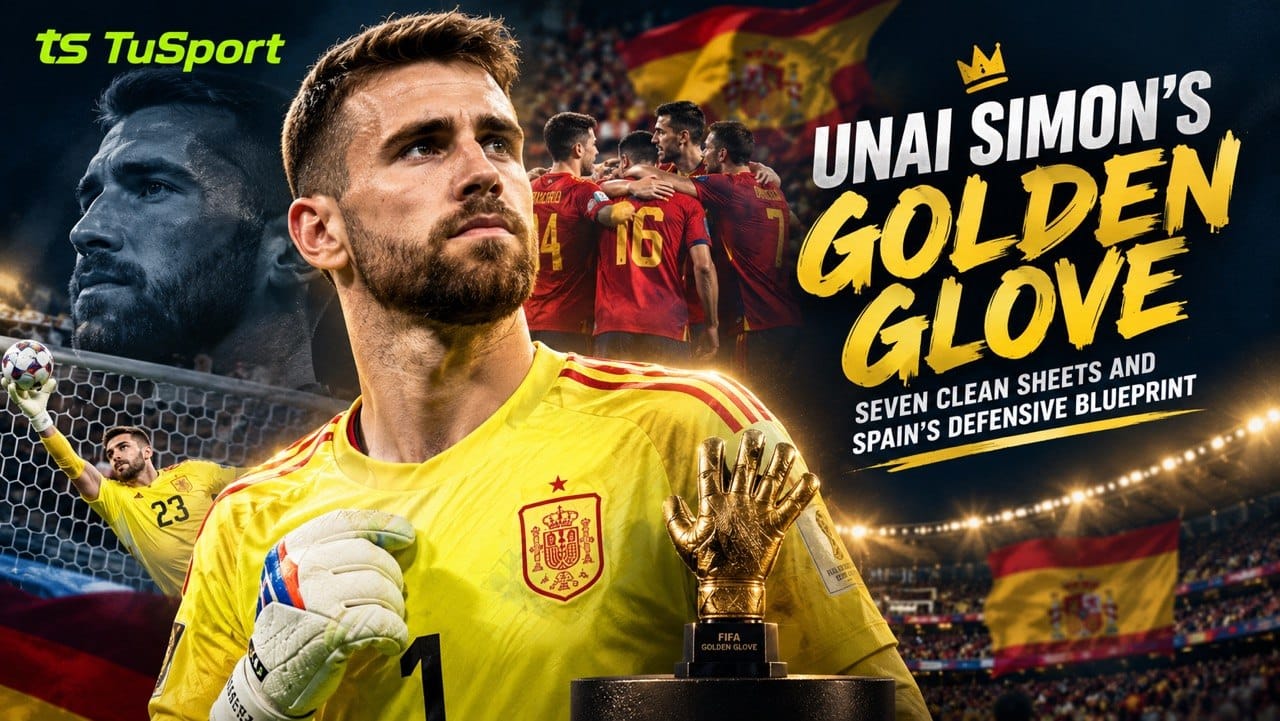
Unai Simon, the Athletic Bilbao goalkeeper whose club side finished the season with a goal difference of minus fifteen, walked off the pitch at the New York New Jersey Stadium on July 19 with the FIFA World Cup trophy in one hand and the Golden Glove tucked under his arm. Seven clean sheets. Six hundred and fifty consecutive scoreless minutes. One goal conceded across eight matches, the fewest by any team in World Cup history.
In a tournament full of extraordinary individual performances, Simon produced arguably the most statistically dominant goalkeeping campaign the competition has ever seen.
The Numbers That Rewrote History
Simon finished the tournament with seven clean sheets, breaking the record for the most by a goalkeeper at a single World Cup. He also logged 650 consecutive minutes without conceding, obliterating Italy’s Walter Zenga’s long-standing tournament mark of 517 minutes set at the 1990 World Cup in his home nation.
Spain conceded just one goal across the entire tournament, against Belgium in the quarter-finals, making this the fewest goals any team has ever conceded on the way to winning a World Cup. In the final against Argentina, Simon was not called upon to make a single save, the first time a World Cup-winning goalkeeper has completed a final without a save to make.
Spain held their opponents to microscopic expected-goals tallies throughout: Cape Verde to 0.3 xG, Saudi Arabia to 0.14, Uruguay to 0.2, and Austria to 0.32. Even free-scoring France were shackled to 0.3 xG in the semi-final. In the final, Argentina were restricted to a mere 0.13 xG, the lowest figure Spain recorded against any opponent all tournament.
Yet despite those record-breaking numbers, Simon ranked twentieth for saves made among all goalkeepers at the tournament, and dead last among those who reached the quarter-finals. He was the best goalkeeper in the competition precisely because he barely had to save anything. That paradox is the whole story.
The System That Made It Possible
Understanding Simon’s Golden Glove requires understanding what happened in front of him.
Spain’s defensive structure began with their forward line pressing furiously to deny opposition players time on the ball. Behind them, Rodri anchored the midfield, screening and recycling possession with the statistical dominance documented throughout this tournament. In front of Simon, 19-year-old Pau Cubarsi and Aymeric Laporte formed a central defensive partnership that conceded just one goal across eight matches.
Simon’s role within that system was not passive. He operated as a modern sweeper-keeper, positioning himself 25 yards from his goal line, constantly reading the angle of the ball and the body language of opposition passers. He finished the World Cup with 22 sweeper interventions, more than any other goalkeeper in the competition, and added eight aerial claims that dominated high deliveries and stripped opponents of set-piece second chances.
The semi-final against France illustrated this proactive philosophy most clearly. Facing Kylian Mbappe normally forces defensive lines to drop deeper due to his pace, but Spain refused to retreat. Simon repeatedly charged out of his penalty box to intercept through-balls before Mbappe could hit top gear. In the 81st minute, his sliding clearance outside the box forced him to recover rapidly to save Desire Doue’s follow-up shot, but had he stayed on his line, Mbappe would have had a clear breakaway.
In the fifth minute of the World Cup final, he sprinted nearly 40 yards from his net to clear a through-ball just as Lionel Messi broke past the backline. That single intervention, taken with complete conviction and extraordinary positioning, may have been the moment that settled the match before it truly began.
Why He Started Ahead of Raya and Garcia
The selection decision that preceded all of this was not obvious from the outside. Simon had to hold off stiff competition from Raya and Garcia, both of whom had stronger domestic seasons. Simon’s own club, Athletic Bilbao, had finished with a goal difference of minus fifteen.
The answer lay in the partnership between Simon and coach Luis de la Fuente, which dates back over a decade. De la Fuente had coached Simon through Spain’s youth system, winning the European Under-19 Championship in 2015 and later the Under-21 title, before reuniting with the senior squad when De la Fuente took the head coach role in early 2023. Together they had won the UEFA Nations League, Euro 2024, and now the World Cup. Simon had never let his country down in that entire period.
The trust was not blind faith. It was grounded in Simon’s specific adaptation of his game for the Spanish system. At Bilbao, he operates in a high-workload domestic environment, facing frequent shots, cross bombardment, and transitional threats. For Spain, he goes long periods without touching the ball and then must make game-changing decisions 30 yards off his line at a moment’s notice. That mental adaptability, the ability to shift between two completely different demands of the same position, is what De la Fuente saw in him that the statistics alone could not capture.
“I feel proud of him,” De la Fuente said during the tournament. “I feel like he is a member of my family.”
Where He Stands in Spanish Goalkeeping History
This World Cup performance stands as potentially the best individual goalkeeper campaign in Spanish national team history, even ahead of Iker Casillas, who remains widely considered the greatest Spanish goalkeeper of all time.
That is an extraordinary claim. Casillas won the 2010 World Cup and two European Championships. His legacy is built across the greatest period in Spanish football history.
What Simon has done in 2026 is produce numbers Casillas never reached at a single tournament: seven clean sheets, 650 consecutive scoreless minutes, one goal conceded across eight matches. He has now won Euro 2024 and the World Cup with Spain, keeping three clean sheets in six matches at the European Championship before following it with this historic campaign in North America.
The debate around the two men will run for years. What is not debatable is that Simon’s 2026 tournament stands as the single most statistically complete goalkeeping performance in World Cup history, produced by a goalkeeper who barely had to make a save to achieve it.
That is how dominant Spain were. And that is how good Unai Simon is.
Follow for daily post-tournament analysis, player profiles, and the latest football news.
Analysis: Pau Cubarsi, The 19-Year-Old Who Kept Messi Quiet in the 2026 World Cup Final
Analysis: Ronaldo’s Farewell, Six World Cups and a Record No One Will Ever Break