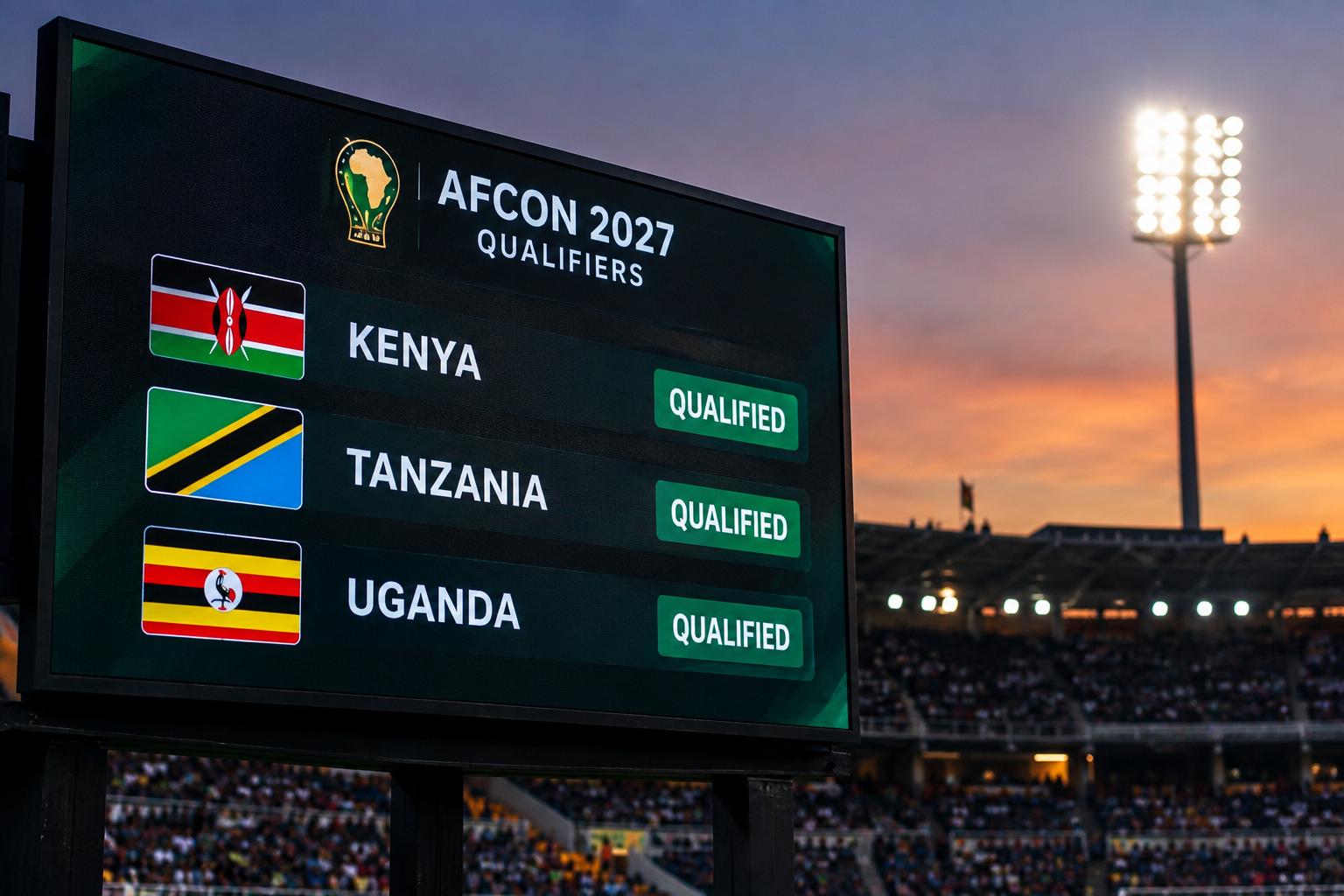
Three teams. That is the full list of confirmed AFCON 2027 qualifiers as things stand, and all three got there without kicking a competitive ball toward that specific goal. Here is exactly who is in, who is still fighting for a place, and when the rest of the picture will become clear.
Key Takeaways
- Kenya, Tanzania and Uganda are the only confirmed AFCON 2027 qualifiers so far, securing their places automatically as co-hosts.
- The remaining 21 spots are being decided through 12 qualifying groups of four teams, with the campaign running through November 2026.
- No qualifying group has finished as of this writing, so no team has qualified purely on results yet.
- The final round of group matches in November 2026 will confirm both the 12 automatic group winners and the nine best-ranked runners-up who complete the 24-team field.
- This page is a snapshot, not a final list, and will be updated as each qualifying window closes.
Confirmed So Far: The Three Co-Hosts
| Nation | Qualification Route |
|---|---|
| Kenya | Automatic, co-host |
| Tanzania | Automatic, co-host |
| Uganda | Automatic, co-host |
Kenya, Tanzania and Uganda earned their AFCON 2027 places the moment their joint hosting bid was confirmed, a standard rule for any tournament with host nations. That guarantee holds regardless of how each team performs in its own qualifying group, though all three are still playing a full campaign for form and momentum rather than survival.
Why Nobody Else Has Qualified Yet
Every other spot at AFCON 2027 is being decided through open qualification, and as of this writing, not a single qualifying group has been completed. Forty-eight nations were drawn into 12 groups of four back in May 2026, and those groups are working through a schedule of six matches each, split across three separate windows between September and November 2026.
Until a group’s full round robin is finished, no team can be mathematically confirmed as a winner, and the runner-up rankings that decide the remaining nine places cannot be calculated until every group has played its final fixture. That is why the qualified list looks so short this early in the campaign, even with matches already under way.
For the complete breakdown of every qualifying group, which teams are in each one, and how the format actually decides the final nine places, our guide to the AFCON 2027 qualifiers covers the mechanics in full.
How the Rest of the Field Gets Decided
Two separate pools make up the remaining 21 spots. The 12 group winners are on track to qualify automatically once their groups conclude, following the format CAF has used in recent AFCON qualifying cycles. The other nine places go to the best-performing runners-up across all 12 groups, ranked by points, then goal difference, then goals scored.
That second pool is where qualification gets genuinely unpredictable. A team can finish second in a tough group with a strong points total and still miss out to a runner-up from a weaker group who racked up more wins against lower-ranked opposition. It typically stays uncertain right up until the final matchday in November 2026.
Groups Worth Watching Early
A few groups stand out already for how they could shape the runner-up picture later. Tanzania’s Group L includes Nigeria, arguably the strongest side in the qualifying pool as a whole, which means Tanzania’s own qualifying form could end up affected by playing a heavyweight rather than a straightforward group. Kenya’s Group D pairs the co-host with South Africa, a side with its own AFCON pedigree, while Uganda faces Tunisia in Group H, another traditionally strong North African qualifier.
None of that changes any of the three hosts’ guaranteed finals places, but it does affect which non-host teams end up fighting hardest for the runner-up places elsewhere, since a group containing two strong sides tends to produce a runner-up with a stronger points total than a group where one team is dominant and the rest are weaker.
When to Expect the Full Picture
Qualifying runs through three windows: matchdays 1 and 2 in September 2026, matchdays 3 and 4 in October 2026, and matchdays 5 and 6 closing things out in November 2026. Realistically, the clearest sense of who is through will not arrive until that final November window wraps up, since so much of the runner-up picture depends on results across every group, not just the ones involving traditional heavyweights.
Some group leaders will likely be mathematically safe before then, particularly if a team builds a big enough points cushion by October. We will update this tracker as those situations become clear rather than waiting for the very last matchday across the board.
Keep Following the Race
Between now and November, the qualifying picture will shift with every international window. For the tournament context behind all of this, including the venues, dates and format for the finals themselves, our complete guide to AFCON 2027 is the place to start, and our full 2027 African football calendar shows how the qualifying campaign fits alongside everything else happening in African football this year. Check back here as each group is settled. We will keep this list current all the way through the final round of fixtures.