Forty-eight nations, twelve groups, and only twenty-one spots up for grabs. That is the maths behind AFCON 2027 qualifying, the process deciding who joins hosts Kenya, Tanzania and Uganda at next summer’s tournament. Here is exactly how the groups are shaped, when the remaining matchdays fall, and what it takes for a team to punch its ticket.
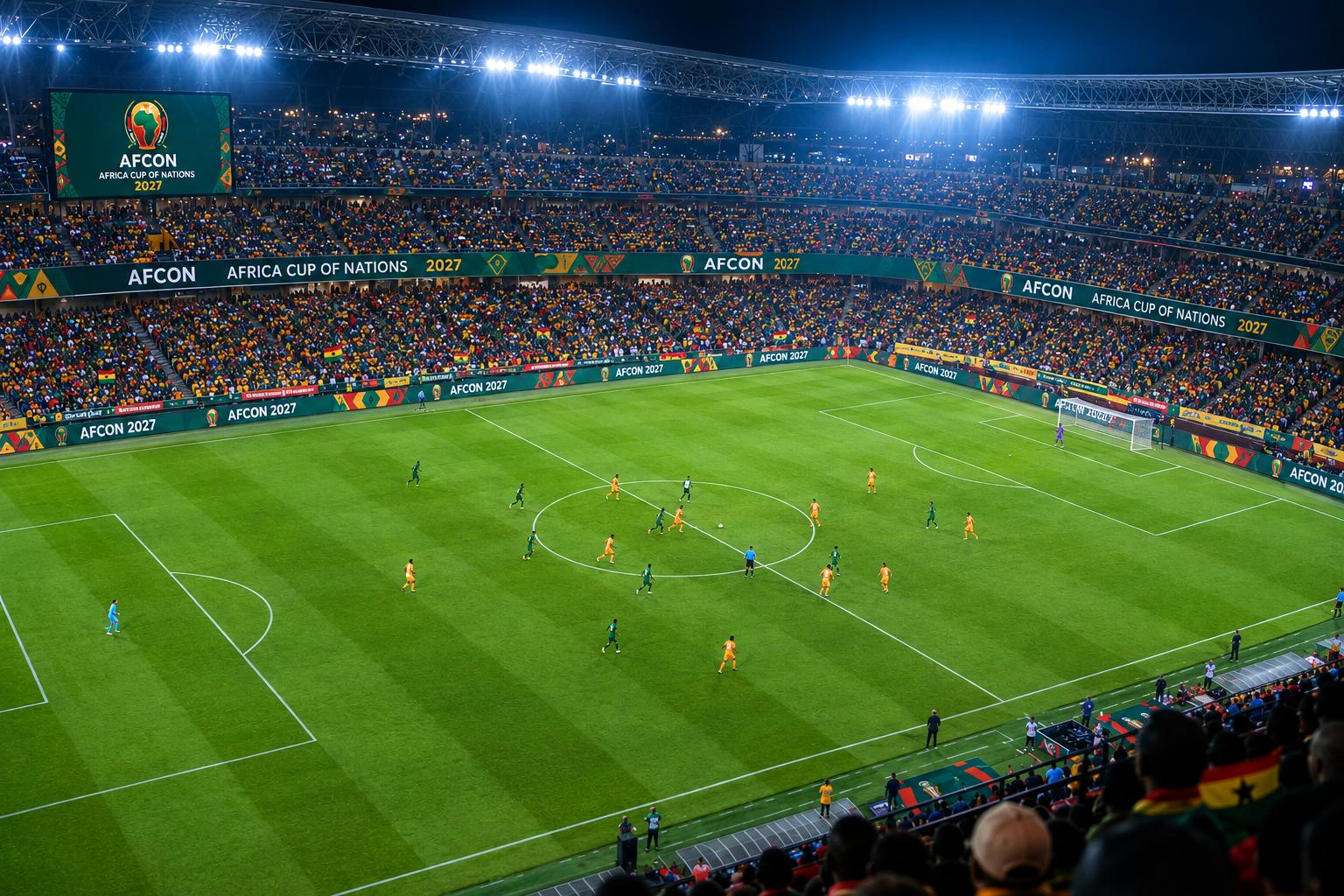
Key Takeaways
- 48 nations were drawn into 12 qualifying groups of four after a preliminary knockout round eliminated the continent’s lowest-ranked sides in March 2026.
- Kenya, Tanzania and Uganda are guaranteed AFCON 2027 spots as co-hosts but still play a full qualifying campaign in Groups D, H and L.
- Group winners are expected to qualify automatically, with the best-ranked runners-up filling the remaining places to reach 21 non-host qualifiers.
- Qualifying is being played across three windows, running from September through November 2026.
- No group has finished as of this writing, so the 2027 finals field will not be locked in until the final matchday closes.
How AFCON 2027 Qualifying Is Structured
AFCON 2027 qualifying decides 21 of the tournament’s 24 places, since Kenya, Tanzania and Uganda already hold their spots as co-hosts. Fifty-four nations originally entered the process, with a preliminary knockout round in late March 2026 trimming the field of its lowest-ranked entrants before 48 teams were confirmed for the group phase.
Those 48 sides were split into 12 groups of four at a draw held at the Egyptian Football Association’s headquarters in Cairo. Each group plays a home-and-away round robin, six matches per team, spread across three qualifying windows between September and November 2026.
The 12 Qualifying Groups
| Group | Teams |
|---|---|
| A | Morocco, Gabon, Niger, Lesotho |
| B | Egypt, Angola, Malawi, South Sudan |
| C | Côte d’Ivoire, Ghana, Gambia, Somalia |
| D | South Africa, Guinea, Kenya, Eritrea |
| E | DR Congo, Equatorial Guinea, Sierra Leone, Zimbabwe |
| F | Burkina Faso, Benin, Mauritania, Central African Republic |
| G | Cameroon, Comoros, Namibia, Congo |
| H | Tunisia, Uganda, Libya, Botswana |
| I | Algeria, Zambia, Togo, Burundi |
| J | Senegal, Mozambique, Sudan, Ethiopia |
| K | Mali, Cape Verde, Rwanda, Liberia |
| L | Nigeria, Madagascar, Tanzania, Guinea-Bissau |
A few groups stand out immediately. Morocco, the defending AFCON champions, face a relatively open Group A, while Group C throws Côte d’Ivoire and Ghana, two West African heavyweights, into the same pool alongside Gambia and Somalia. Nigeria’s group in Group L is the one to watch most closely for East African fans, since it includes co-host Tanzania.
How Hosts Kenya, Tanzania and Uganda Fit In
Kenya sit in Group D alongside South Africa, Guinea and Eritrea. Tanzania are in Group L with Nigeria, Madagascar and Guinea-Bissau. Uganda play in Group H against Tunisia, Libya and Botswana.
None of the three need a result to book their place at AFCON 2027, since host status already guarantees it. That does not make their qualifying campaigns meaningless, though. A strong run through the group builds match sharpness and confidence heading into a tournament every host nation wants to avoid crashing out of in the group stage, and it gives coaching staff a real competitive gauge rather than a string of friendlies.
For the full story on why three nations are sharing hosting duties and what the tournament itself looks like, our complete guide to AFCON 2027 covers the venues, format and the road to kickoff in detail.
How the Remaining 21 Spots Get Decided
The 12 group winners are on track to qualify automatically, mirroring the format CAF used for the last two AFCON qualifying cycles. That leaves nine places still to fill, which go to the best-performing runners-up across all 12 groups once every table is complete, ranked by points, then goal difference and goals scored.
That structure rewards consistency far more than one big result. A team that finishes second in a brutally difficult group can still miss out to a runner-up from an easier group who racked up more points against weaker opposition, which is exactly why the final round of fixtures in November 2026 tends to produce late, dramatic swings in the qualification picture.
Qualifying Windows and Key Dates
Qualifying is being played across three FIFA international windows rather than in one continuous block, giving federations time to prepare between rounds:
- Matchdays 1 and 2 ran in September 2026, kicking off the group phase in earnest.
- Matchdays 3 and 4 follow in October 2026, the midpoint of the campaign where early group leaders start to separate from the pack.
- Matchdays 5 and 6 close out the group phase in November 2026, deciding both the automatic qualifiers and the runner-up rankings.
Because qualifying spans three separate windows rather than a single condensed block, form can shift significantly between rounds, especially for teams juggling call-ups from European, Gulf or Asian clubs.
What Happens Once Qualifying Wraps Up
Once the November 2026 fixtures are done and every group table is final, the full 24-team AFCON 2027 lineup will be set. We are tracking every confirmed qualifier as the groups get settled in our running list of teams that have qualified for AFCON 2027 so far, updated after each matchday closes.
Beyond the qualifiers themselves, 2027 is a packed year for CAF competitions more broadly, from continental club football to youth tournaments running alongside the senior qualifying campaign. Our full 2027 African football calendar lays out how everything fits together, and once the AFCON 2027 fixture list itself drops, TuSportNews will publish match predictions and tactical previews for every group and knockout tie. Until then, the twelve groups above are the ones worth bookmarking.