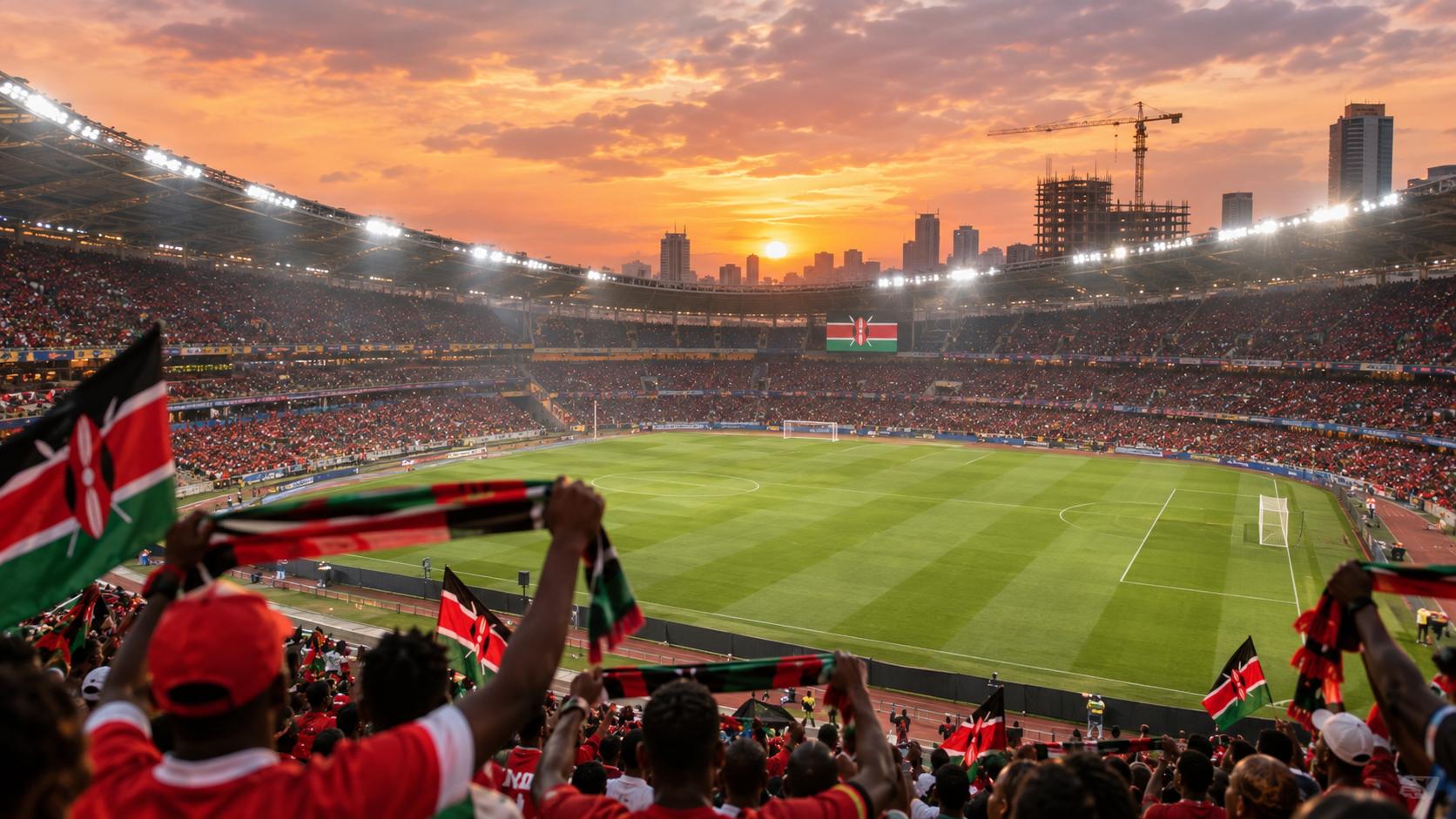
Kenya has played at the Africa Cup of Nations six times, spread across nearly half a century, and has won exactly two matches in all of them. The Harambee Stars have never once made it out of the group. In June 2027 they will try again, only this time the tournament comes to them, and their place was settled years before a ball was kicked.
A guaranteed place sounds like a gift, but it also means a home crowd in Nairobi that will not take another early exit quietly.
Key Takeaways
- Kenya qualified automatically as co-host of AFCON 2027, which runs from 19 June to 17 July 2027 across Kenya, Tanzania and Uganda.
- The Harambee Stars still play a full qualifying campaign in Group D against South Africa, Guinea and Eritrea, and those results count in the table.
- Kenya has appeared at AFCON six times, won two matches and never escaped the group stage, so a first knockout place is the realistic target.
- Government officials have publicly asked for a title challenge, though Kenya sit 109th in the FIFA rankings.
- Talanta and Kasarani both passed through CAF inspections in 2026 with follow-up work still to finish, so stadium readiness stays a live storyline.
Why Kenya Is Already Qualified for AFCON 2027
Kenya qualified as one of three co-hosts, and hosts do not have to earn a place through qualifying. CAF awarded the 2027 tournament to Kenya, Tanzania and Uganda on 26 September 2023, in the same announcement that gave the 2025 edition to Morocco.
It is a big moment for the region. The CECAFA zone last hosted the tournament in 1976, when Ethiopia staged it, so East and Central Africa had waited almost half a century for another turn.
Of the 24 places in the field, three are already gone. Our complete guide to AFCON 2027 covers the full format, the ten venues and why CAF split the tournament three ways.
How the Harambee Stars Are Preparing
A guaranteed place removes the qualifying stress but not the need for match practice. Kenya’s preparation runs on two tracks, a live qualifying group and a coach who has been building since early 2025.
1. A Qualifying Group That Still Counts
Kenya were drawn into Group D with South Africa, Guinea and Eritrea, and the hosts are treated as ordinary participants whose results count in the standings. They cannot fail to qualify, but they can still finish top, and they can still lose.
The first home match is against Eritrea at Nyayo National Stadium on 26 September, followed by a trip to Conakry to face Guinea on 1 October. The final round of qualifiers runs from 22 to 30 March 2027, which means Kenya keep playing competitive fixtures right up to the summer. Our AFCON 2027 qualifiers guide tracks every group and matchday.
2. Benni McCarthy and a Mixed Squad
Benni McCarthy was unveiled as head coach on 3 March 2025, and the Kenyan federation said his contract runs until AFCON 2027. The former South Africa striker, who also played in the Premier League, was hired to build a more professional and disciplined culture around the team.
His September squad mixes home-based players, with Gor Mahia supplying the most names, and overseas talent such as Charlton Athletic’s Timothy Ouma and Real Sociedad’s Job Ochieng. Michael Olunga, the captain, remains the focal point up front. If you want the background on the team itself, our explainer on who the Harambee Stars are covers the name, the history and the current setup.
3. A Ranking That Shows the Size of the Task
Kenya sat 109th in the FIFA rankings as of 20 July 2026. That is the honest starting point, and it puts the Harambee Stars well outside the continent’s top group.
Rankings move slowly and hosts tend to lift their level at home, but the gap to the leading African sides is real. It shapes what a sensible target looks like.
Are Kenya’s AFCON 2027 Stadiums Ready?
Kenya will stage matches in Nairobi across two main venues plus a smaller third, and CAF inspectors have been in and out through 2026. The picture from early September was positive but unfinished.
| Venue | Role | Status in Early September 2026 |
|---|---|---|
| Raila Odinga International Stadium (Talanta) | Main new-build, 60,000 seats | Positive CAF assessment, about 95% complete against the original design |
| Moi International Sports Centre, Kasarani | Renovated existing stadium | About 95% complete, with CAF asking for extra media and press facility work, target December 2026 |
| Nyayo National Stadium | Smaller Nairobi venue | Hosting Kenya’s home qualifier against Eritrea |
Kenya was reported to have scored around 80% on hosting readiness after the most recent visit. The pitch at Talanta drew online worry in early September when sections were dug up for synthetic fibre stitching, which the Sports Cabinet Secretary, Salim Mvurya, described as no cause for alarm.
Late finishing touches are common on projects this size. The real test is whether the December Kasarani target and the follow-up CAF checks are met without more slippage.
Can the Harambee Stars Finally Get Out of the Group?
A knockout place is achievable, and it is the right ambition. Kenya’s six appearances came in 1972, 1988, 1990, 1992, 2004 and 2019, with the only wins arriving in the last two of those, including a 3-2 victory over Tanzania in Egypt.
The format helps more than it used to. With 24 teams in six groups, the top two go through and so do the four best third-placed sides, a much lower bar than the old 16-team tournament set.
Government officials are aiming higher. After an August steering committee meeting, Sports Cabinet Secretary Salim Mvurya publicly set the target at winning the trophy. That is the kind of statement a minister makes and a coach has to live with.
A title run would be a giant leap for a team ranked 109th. Getting out of the group is a measurable goal, and it is the one that would actually change how Kenyan football sees itself.
What to Watch Between Now and June 2027
The next nine months are packed, and a few checkpoints will tell you a lot about where Kenya really stands.
- The September and October qualifiers against Eritrea and Guinea, and how McCarthy’s side handles South Africa in the matches after them.
- Kasarani’s December 2026 completion target and CAF’s next inspection report.
- The March 2027 qualifying finale, the last competitive test before the tournament.
- The final draw, which will decide who Kenya face and where.
The 2027 African football calendar lays out how those dates fit around the rest of the continent’s fixtures. Once the draw is made, the fixtures will also be covered on the AI predictions hub.
Kenya’s Best Chance to Break the Group-Stage Ceiling
Kenya has every structural advantage a host could ask for, from a settled coach and a guaranteed place to home crowds, familiar pitches and a friendlier format. The remaining questions are whether the stadiums are finished on time and whether McCarthy can shape a squad ranked 109th into one that wins two group games.
Reaching the round of 16 would be the first knockout appearance in Kenya’s history. For a national team that has waited more than fifty years since its first finals, that is a fair target, and it is one the greatest Kenyan footballers of all time never had the chance to chase in front of their own supporters.