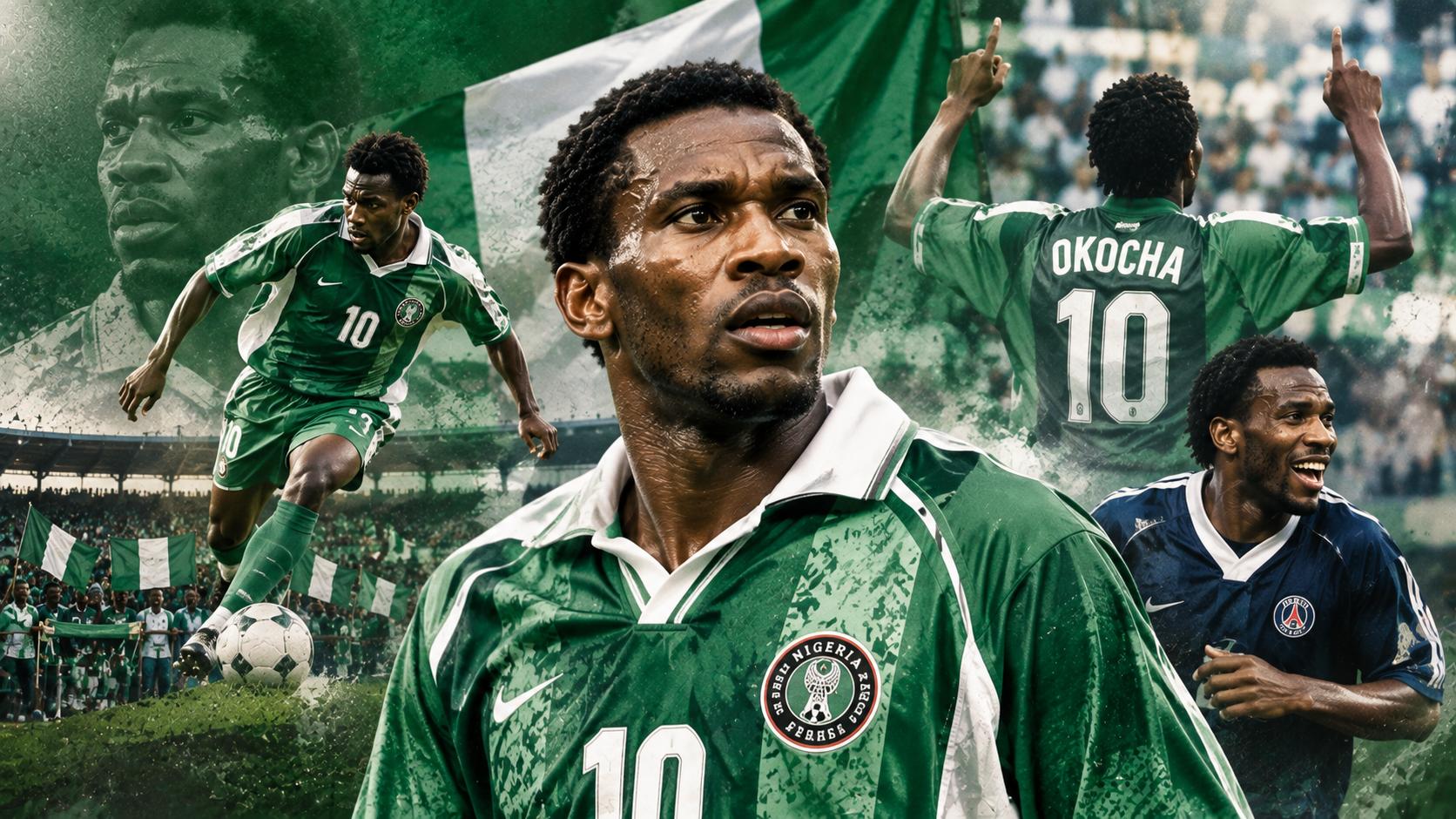
At Bolton Wanderers, the fans had a chant for him: “Jay-Jay, so good they named him twice.” The chant played on his doubled nickname, which Augustine Azuka Okocha inherited from his elder brother James, and it stuck because the football matched it.
Okocha played for seven clubs across five countries, and the way he carried the ball never changed. Defenders in Germany, Turkey, France and England all had to deal with it.
Last updated: 19 October 2026.
Key Takeaways
- Okocha was born in Enugu on 14 August 1973 and played as an attacking midfielder for Nigeria from 1993 to 2006.
- He dribbled past goalkeeper Oliver Kahn to score for Eintracht Frankfurt in 1993, a goal voted German Goal of the Year.
- Paris Saint-Germain paid £14 million for him in 1998, which made him the most expensive African player at the time.
- He won the 1994 Africa Cup of Nations and 1996 Olympic gold, and was BBC African Footballer of the Year in 2003 and 2004.
- Bolton fans voted him the club’s best-ever player in 2017.
Who Is Jay-Jay Okocha?
Jay-Jay Okocha is a Nigerian former attacking midfielder who won 73 caps and scored 14 goals for the Super Eagles between 1993 and 2006. He played club football in Germany, Turkey, France, England and Qatar, and finished his career at Hull City.
Ruud Gullit called him “a delightful player to watch” who could do incredible things with the ball and, like Zidane, make it look easy.
Okocha’s Career at a Glance
| Club | Years | Note |
|---|---|---|
| Borussia Neunkirchen | 1990 to 1992 | First senior club in Germany |
| Eintracht Frankfurt | 1992 to 1996 | 1993 Goal of the Year |
| Fenerbahçe | 1996 to 1998 | 30 goals in 62 games |
| Paris Saint-Germain | 1998 to 2002 | £14 million, then a record for an African player |
| Bolton Wanderers | 2002 to 2006 | 124 appearances, free transfer |
| Qatar SC | 2006 to 2007 | Short spell in the Gulf |
| Hull City | 2007 to 2008 | 18 appearances, promotion squad |
Early Life: Street Football in Enugu
Augustine Azuka Okocha was born on 14 August 1973 in Enugu, in south-eastern Nigeria. His family is from Ogwashi-Ukwu in Delta State, and he is Igbo. The “Jay-Jay” nickname came from his elder brother James, and when his brother Emmanuel was also given a version of it, it was Augustine who kept the name for good.
Like many players of his generation, he learned the game on the street, using makeshift balls. He has said they played with “any round thing” they could find, which helps explain where the close control came from. In 1990 he joined Enugu Rangers, the same club that won the 2025/26 NPFL title, as our guide to how the NPFL works explains.
The move to Europe came through a friend. Binebi Numa played for Borussia Neunkirchen in Germany, and after Okocha joined him in training the coach offered him a contract.
From Enugu to Germany
Okocha grew up in Enugu and moved to Germany as a teenager, joining Borussia Neunkirchen in 1990. He then signed for Eintracht Frankfurt in 1992, where his career took off.
The moment that made him famous came against Karlsruher SC in 1993. He dribbled past Oliver Kahn, then in goal for Karlsruhe, and scored. Viewers of the German programme Sportschau voted it the Goal of the Year.
Frankfurt in Numbers
Okocha played 90 Bundesliga games for Eintracht Frankfurt and scored 18 goals, or 25 in 116 appearances across all competitions. He was in the squad that was relegated in 1996, and his departure followed a falling-out with manager Jupp Heynckes in 1995. A short stay at 1. FC Saarbrücken sits between Neunkirchen and Frankfurt on his record.
Fenerbahçe and Paris Saint-Germain
Fenerbahçe signed him in 1996 for a fee reported at about £1 million, and he scored 30 goals in 62 appearances for the Turkish club. It was the most prolific spell of his career and the one that put him on the radar of bigger clubs.
Paris Saint-Germain paid £14 million for him in 1998, which made him the most expensive African player at the time. If you want to understand how a fee that size is set and paid, our explainer on how football transfer fees actually work covers it.
He made 84 appearances and scored 12 goals for PSG over four seasons. The numbers are modest, but the fee said what the market thought of him.
Muhammed Yavuz and Ronaldinho’s Mentor
Two details from these years show how fully he committed to each club. In Turkey, Okocha took Turkish citizenship and played under the name Muhammed Yavuz, with Muhammed chosen, he said, for its popularity in Islam, though he did not change his religion. Many of his Fenerbahçe goals came from direct free kicks.
At Paris Saint-Germain he mentored a young Ronaldinho, and the club shared the 2001 Intertoto Cup, in which Okocha scored five goals.
The Bolton Years
Sam Allardyce signed Okocha on a free transfer in 2002, shortly after the World Cup in Japan and South Korea. Allardyce described him as a player with “a great pedigree” who had flair, ability and huge experience.
The move worked for both sides. Okocha made 124 appearances for Bolton, and he scored a decisive goal on the final day of the 2002/03 season against Middlesbrough, a 2-1 win that helped keep the club in the Premier League.
Bolton reached the 2004 League Cup final, where they lost 2-1 to Middlesbrough at the Millennium Stadium. Okocha had played a big part in the run there, including a free kick against Liverpool in the fourth round and an early free kick against Aston Villa in the semi-final first leg, which Bolton won 5-2.
A solo goal against West Ham on 19 April 2003 was later voted Bolton’s best Premier League goal, and in 2017 supporters voted him the greatest player in the club’s history.
Bolton by the Numbers
- Signed on a free transfer in June 2002.
- Scored seven goals in his first season and was named Bolton Player of the Year for 2002/03.
- Won the Premier League Player of the Month award for November 2003.
- Captained the club to the 2004 League Cup final.
- Made 124 league appearances and scored 14 league goals before leaving in 2006, after losing the captaincy.
Okocha for Nigeria
Okocha made his Nigeria debut in 1993 and won the 1994 Africa Cup of Nations, the country’s second title. He then played at the 1994 World Cup and was part of the team that won Olympic gold in Atlanta in 1996.
At the 1998 World Cup he was in the side that beat Spain 3-2 in the group stage, and he was named in the tournament’s reserve All-Star team. He also scored four goals at the 2000 Africa Cup of Nations, captaining the side and netting the equaliser in the final, where Nigeria lost to Cameroon on penalties.
Nigeria finished third at the Africa Cup of Nations in 2002, 2004 and 2006, and Okocha was named the best player at the 2004 tournament. Our complete guide to AFCON 2027 covers the tournament Nigeria will target next.
Okocha’s Nigeria Record at a Glance
| Item | Detail |
|---|---|
| Caps and goals | 73 caps, 14 goals (1993 to 2006) |
| First goal | An equaliser against Algeria in 1993, which helped Nigeria qualify for their first World Cup |
| Africa Cup of Nations | Winner 1994, runner-up 2000, third place 2002, 2004 and 2006 |
| Best AFCON moments | Four goals at the 2000 tournament and four more in 2004, when he was named best player |
| World Cups | Three squads: 1994, 1998 and 2002 |
| 1994 World Cup | Set a record with 15 dribbles in one match, against Italy |
| 1998 World Cup | Named in the reserve All-Star team |
| Olympics | Gold medal, Atlanta 1996 |
How Okocha Played
Okocha was an attacking midfielder and playmaker whose game was built on close control, dribbling and feints. His signature move was the stepover, which he used to unbalance defenders before changing direction. He also had a powerful long-range shot, was a dangerous free-kick taker and could produce long throw-ins.
The criticism that followed him was about inconsistency and a lack of tactical discipline. Ruud Gullit’s verdict, that he was a delightful player to watch who made hard things look easy, sums up why that rarely mattered to supporters.
Awards and Recognition
Okocha was BBC African Footballer of the Year in 2003 and 2004. In March 2004, Pelé named him in the FIFA 100, the list of the greatest living players.
His last club was Hull City, which he joined on a free transfer in 2007. He made 18 appearances, and the team won promotion to the top flight in 2008.
Honours and Awards Summary
| Award or honour | Year |
|---|---|
| Africa Cup of Nations winner | 1994 |
| Olympic gold medal | 1996 |
| BBC African Footballer of the Year | 2003 and 2004 |
| Africa Cup of Nations best player | 2004 |
| Bolton Wanderers Player of the Year | 2002/03 |
| Premier League Player of the Month | November 2003 |
| FIFA 100 (selected by Pelé) | 2004 |
| German Goal of the Year (v Karlsruher SC) | 1993 |
| Added to the IFFHS all-time Africa Men’s Dream Team | 2021 |
Life After Football
Off the pitch, Okocha set up the Jay-Jay Okocha Foundation, which promotes education, peace and unity in Nigeria through football. He has also stayed visible in the game as a pundit and in charity matches.
Media, Administration and Legend Status
Okocha was added to the FIFA video game as a Legend in 2014 and was elected chairman of the Delta State Football Association in February 2015. In April 2015 he said he was interested in the presidency of the Nigeria Football Federation. Since 2019 he has worked as a pundit for SuperSport, covering the Africa Cup of Nations and the European Championships, and he still turns out in legends games, scoring a penalty in a 2021 Bolton legends match and a hat-trick in a 2016 charity game.
A Family Tradition: Alex Iwobi and Emmanuel Okocha
Football runs in the family. His brother Emmanuel was also a Nigerian international, and his nephew is Alex Iwobi, who plays for Fulham and Nigeria and has been one of the most-capped players of the current Super Eagles squad. Our explainer on who the Super Eagles are covers the squad that Iwobi leads today.
Jay-Jay Okocha FAQ
How old is Jay-Jay Okocha?
Okocha was born on 14 August 1973, so he turned 53 in August 2026.
Where was Jay-Jay Okocha born?
In Enugu, Nigeria. His family is from Ogwashi-Ukwu in Delta State.
Why is he called Jay-Jay?
The nickname came from his elder brother James, and it stuck with Augustine after his other brother Emmanuel was also nicknamed in the same style.
How many caps did Okocha win for Nigeria?
He won 73 caps and scored 14 goals between 1993 and 2006.
Which clubs did Jay-Jay Okocha play for?
Borussia Neunkirchen, 1. FC Saarbrücken, Eintracht Frankfurt, Fenerbahçe, Paris Saint-Germain, Bolton Wanderers, Qatar SC and Hull City.
What trophies did he win?
He won the 1994 Africa Cup of Nations and the 1996 Olympic gold medal with Nigeria. At club level he shared the 2001 Intertoto Cup with Paris Saint-Germain, and he finished at Hull City in the season the club won promotion to the Premier League.
Why do Bolton fans love him?
Bolton supporters voted him the best player in the club’s history in 2017. He arrived on a free transfer, captained the side to a League Cup final and scored some of the club’s best-remembered goals.
Did Okocha play for the Super Eagles at the World Cup?
Yes. He was in Nigeria’s squads for the 1994, 1998 and 2002 tournaments.
Why Okocha Still Matters
Okocha showed that a Nigerian playmaker could be the best player on the pitch in Germany, France and England, and that he could win trophies for his country while doing it. Where he sits among his peers is covered in our ranking of the greatest Nigerian footballers of all time.
For a look at how today’s players find their route into that same pipeline, our guide to Nigeria’s football pyramid traces the path from grassroots to the Super Eagles. If you watch old clips of Okocha, look at how he uses the ball to beat the man rather than the space, because that is what made him special.