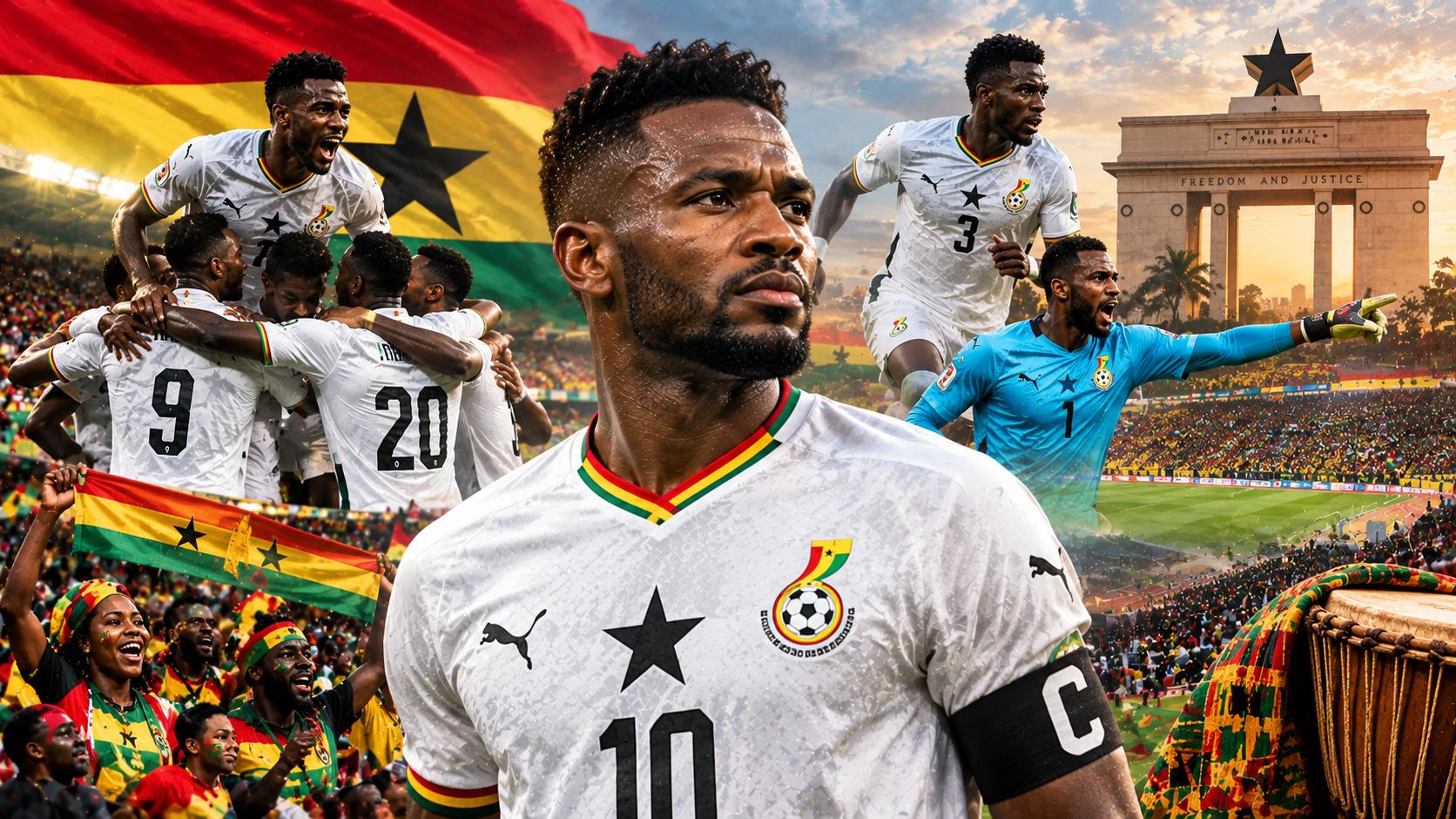
The Black Stars is the nickname of Ghana’s men’s national football team, taken directly from the black star at the centre of the country’s flag. That symbol traces back further still, to Marcus Garvey’s Black Star Line, a shipping company founded between 1919 and 1922 as part of the Back-to-Africa movement, making Ghana’s team name one of the more directly political nicknames in world football.
Key Takeaways
- Ghana’s “Black Stars” nickname comes from the black star on the national flag, itself inspired by Marcus Garvey’s Black Star Line shipping company.
- Ghana have won the Africa Cup of Nations four times, in 1963, 1965, 1978 and 1982, but have not added a fifth title since.
- Asamoah Gyan is Ghana’s all time top scorer with 51 goals, while Jordan Ayew holds the appearance record with 124 caps.
- Ghana shockingly failed to qualify for the 2025 AFCON, their first absence from the tournament in roughly two decades.
- Carlos Queiroz took over as head coach in April 2026 ahead of Ghana’s fifth World Cup appearance, where the team reached the round of 32.
Where The Black Stars Name Comes From
Ghana’s flag carries a black five-pointed star at its centre, a deliberate reference to Marcus Garvey’s Black Star Line, the shipping company he founded in the early 1920s to support Black economic independence and the wider Back-to-Africa movement. When Ghana became the first sub-Saharan African nation to gain independence from colonial rule in 1957, that symbol went straight onto the new national flag, and from there onto the football team itself.
Few national team nicknames anywhere in world football carry this direct a link to a specific historical political movement, which is part of why “Black Stars” has remained such a source of pride across generations of Ghanaian fans rather than fading into a purely decorative label.
Read More: Who Are the Desert Foxes? Algeria’s National Football Team Explained covers another African national team nickname with its own distinct origin story.
Ghana’s Golden Era And Four AFCON Titles
Ghana won the Africa Cup of Nations four times in a relatively concentrated stretch, lifting the trophy in 1963, 1965, 1978 and 1982. That run made Ghana one of African football’s dominant early forces, a status the country has never quite recaptured since, despite reaching the final again as recently as 2015, when they finished runners-up.
Forty-plus years without a fifth title is a long wait for a team with this much continental pedigree, and it has become one of the defining storylines around every Black Stars squad heading into a new tournament.
The Shock Of Missing AFCON 2025 Entirely
Ghana’s AFCON story took its most painful recent turn not on the pitch during the tournament itself, but during qualifying for the 2025 edition. A 1-1 draw with Angola sealed Ghana’s elimination from qualification, meaning a four-time African champion missed the tournament outright for the first time in roughly two decades. The result triggered genuine soul-searching within Ghanaian football, given how rarely a nation with this trophy history fails to even reach the group stage.
Kit, Records And The Players Who Built The Reputation
Ghana traditionally play in white at home and yellow away, though the team wore Pan-African gold, green and red kits through parts of the 1990s and into the mid-2000s before settling into their current colours. Asamoah Gyan holds the scoring record with 51 international goals, built across a career that included spells in England, France and the Middle East and multiple World Cup appearances for Ghana. Jordan Ayew holds the appearance record with 124 caps, a testament to remarkable longevity across more than a decade of international selection.
Read More: Nigeria vs Ghana: Inside West Africa’s Fiercest Football Rivalry covers the fixture that best captures how seriously Ghanaian football takes its regional standing.
World Cup History And The Suarez Handball
Ghana have qualified for the World Cup five times, in 2006, 2010, 2014, 2022 and 2026. Their best performance came in 2010, when Ghana reached the quarterfinals, the furthest any African nation had gone at a World Cup at that point, before losing to Uruguay on penalties in a match remembered largely for Luis Suarez’s deliberate handball on the goal line that denied Ghana a stoppage-time winner.
That moment remains one of the most debated incidents in World Cup history, and it left Ghana agonisingly short of becoming the first African team to reach a World Cup semifinal.
Where The Black Stars Stand Today
Carlos Queiroz, the veteran Portuguese coach who has previously led Portugal, Iran, Colombia, Egypt and Qatar at major tournaments, took over as Ghana’s head coach in April 2026 specifically to lead the team into that summer’s World Cup. Ghana finished third in their group at the tournament but still advanced under the expanded format, before being eliminated in the round of 32.
Ghana were ranked 65th in the world as of July 2026, a reasonable position but one that still sits below where a four-time AFCON champion might expect to be, especially after missing the 2025 tournament entirely.
For the tournament Ghana are looking to return to and eventually add a fifth title in, the AFCON hub on TuSportNews and its linked AI Predictions page track fixtures and forecasts as they are confirmed, alongside the broader AI Predictions hub for match forecasts across every league the site currently follows.
A Proud Name Looking For Its Next Chapter
Ghana’s Black Stars carry one of African football’s most politically meaningful nicknames and one of its most decorated early histories, four AFCON titles won across two distinct generations of players. The gap since 1982 has grown long enough, and the shock of missing 2025 painful enough, that the current generation under Carlos Queiroz carries real pressure to prove the name still matches the team’s ambitions. A round of 32 finish at the 2026 World Cup is a start, but for a country that once nearly reached a World Cup semifinal, it is unlikely to be treated as enough on its own.