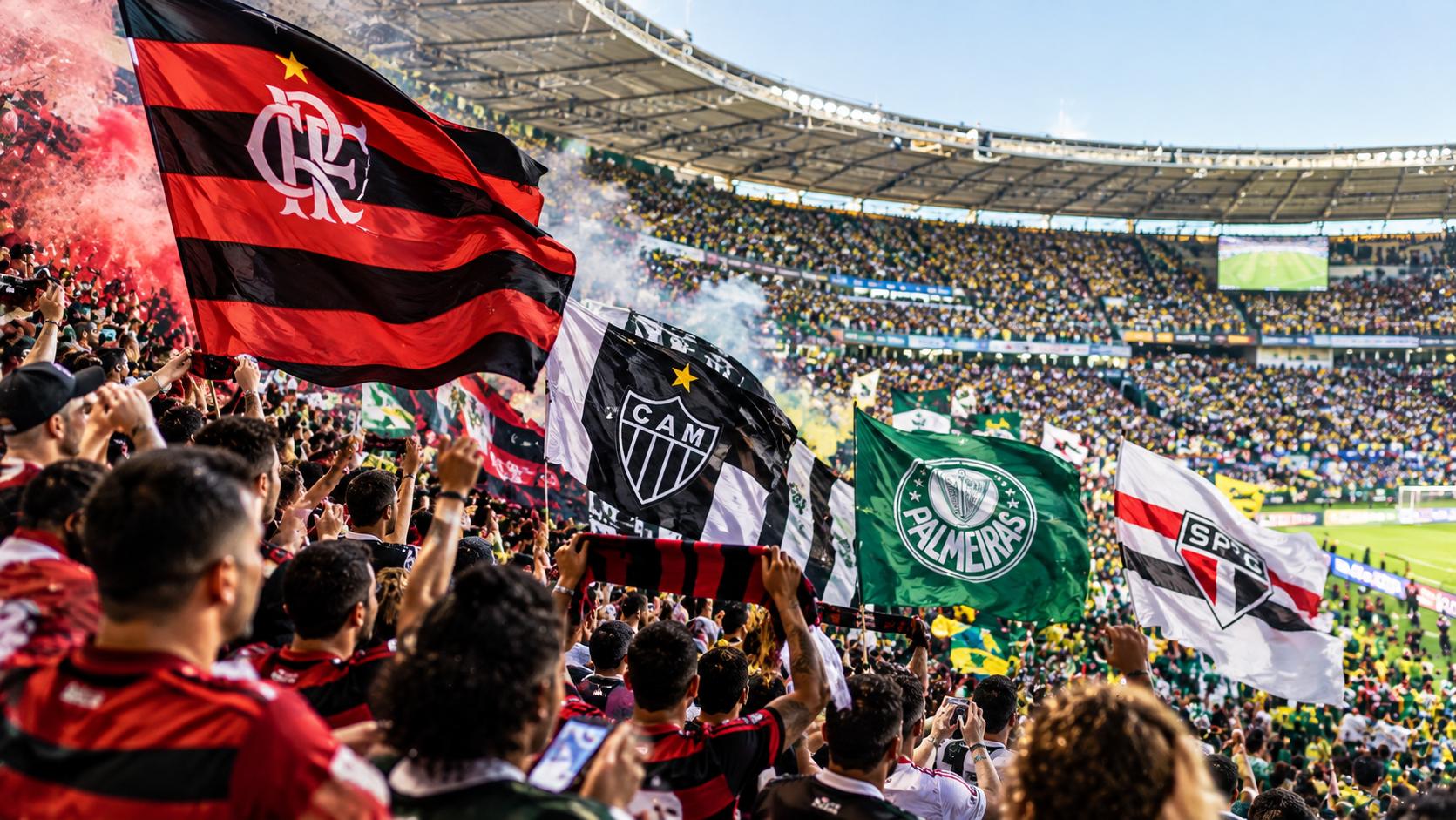
Ask any Brazilian who has the biggest torcida and you will hear two names: Flamengo and Corinthians. The surveys back that up, but the percentages you see online vary quite a bit depending on who ran the poll and how they counted.
In Datafolha’s November 2024 survey, Flamengo had 19% of Brazilians. In a separate InfoMoney study released in March 2025, they had 24.8%. This guide explains why both numbers are fair, how the top ten compares and where the regional strongholds sit.
Key Takeaways
- Flamengo and Corinthians top every major ranking, and in the InfoMoney study together they hold almost half of all fans who named a club.
- Palmeiras and São Paulo are close enough that the margin of error makes them technically tied for third.
- Five northeastern clubs appear in the InfoMoney top 19, led by Sport on 2.7%.
- A big fan base does not always mean a big crowd, which you can see by comparing these rankings with attendance figures.
Two Surveys, Two Sets of Numbers
The two polls measure different things, so their results should not be mixed up.
1. Datafolha (November 2024)
Datafolha asked 2,004 Brazilians aged over 16 across 113 municipalities between 5 and 7 November 2024, with a margin of error of two percentage points. Its percentages cover everyone in the sample, including the 23% who said they follow no team.
2. InfoMoney, TM20 Branding and Brazil Panels (February 2025)
This study surveyed 2,000 people from classes A to E across the country’s five regions between 6 and 20 February, also with a two-point margin of error. It was released at the Sport & Business Summit and counts only respondents who named a favourite club, which pushes every club’s share higher.
That one difference explains most of the gap between Flamengo’s 19% and 24.8%.
The Top 10 Side by Side
| Club | Datafolha (Nov 2024) | InfoMoney (Feb 2025) |
|---|---|---|
| Flamengo | 19% | 24.8% |
| Corinthians | 14% | 19.4% |
| Palmeiras | 7% | 8.1% |
| São Paulo | 6% | 7.7% |
| Vasco | 4% | 4.8% |
| Grêmio | 4% | 4.4% |
| Atlético-MG | 2% | 4.0% |
| Santos | 3% | 3.1% |
| Internacional | 3% | 2.9% |
| Cruzeiro | 3% | 2.7% |
| Sport | not listed | 2.7% |
The order matters more than the exact percentages. Both surveys agree on the order of the first four clubs and on Vasco and Grêmio sitting in the next tier.
Datafolha’s newer poll, with fieldwork on 22 and 23 July 2026, asked 2,004 people aged 16 or over in 139 municipalities, with a two-point margin of error. Flamengo rose to 22% and Corinthians stayed on 14%, with Palmeiras on 7% and São Paulo on 6%. A further 22% said they follow no team.
The Big Two: Flamengo and Corinthians
Flamengo have led Datafolha’s series since 1993, though their share slipped from 21% in 2023 to 19% in 2024. Corinthians held second place and moved from 15% to 14%. No Ataque’s write-up of the Datafolha results noted that television coverage has historically been key to Flamengo’s lead.
The InfoMoney study put the pair at 24.8% and 19.4%, a combined 44.2% of respondents who named a club. Datafolha also found Flamengo’s support is higher among Black and mixed-race Brazilians (23%, against 12% for white Brazilians) and among people earning up to two minimum wages (22%).
The Chasing Pack
Palmeiras (8.1%) and São Paulo (7.7%) are separated by less than the margin of error in the InfoMoney study, so you cannot say one has a bigger base than the other.
Vasco (4.8%), Grêmio (4.4%) and Atlético-MG (4%) form the next group. Datafolha shows the same pattern, with Palmeiras on 7%, São Paulo on 6% and Grêmio and Vasco level on 4%. Cruzeiro’s slip from 4% to 3% in that poll is inside the margin of error, so it is not a real movement.
Santos, Internacional, Cruzeiro and Sport fill the rest of the top ten, with Sport (2.7%) tied with Cruzeiro for tenth. That puts the Pernambuco club ahead of Bahia, who sit on 2.5%.
Read More: What Makes a Football Rivalry
Regional Strongholds
National percentages hide how local football loyalty is. Datafolha found Corinthians lead the Southeast with 20%, while in the South Grêmio (23%) and Internacional (18%) are ahead. Flamengo’s support is strongest outside the Southeast, including around a quarter of fans in the Northeast.
The northeast also stands out in the InfoMoney study, which lists five clubs from the region:
| Club | Share |
|---|---|
| Sport | 2.7% |
| Bahia | 2.5% |
| Vitória | 1.9% |
| Ceará | 1.6% |
| Fortaleza | 1.4% |
Fan Base Versus Stadium Crowd
Surveys count loyalty. Attendance counts who actually turns up, and the two do not always line up. In 2024, Bahia averaged 36,022 paying fans and Fluminense 32,171, placing them fourth and fifth in the league on attendance despite sitting at 2.5% and 2.4% in the InfoMoney ranking.
Flamengo are the exception, because their fans fill the stands as well. They averaged 58,554 per home game in 2025 and have the highest attendance in the Brasileirão.
How to Read a Fan Survey
A few habits make these polls easier to interpret.
- Check who is in the denominator. Datafolha counts everyone, including people with no team. InfoMoney counts only people who named one.
- Allow for the margin of error. Both surveys carry two points either way, so gaps of one or two points between mid-table clubs mean very little.
- Remember the timing. Datafolha fieldwork finished in early November 2024, a month before Botafogo won the league. Even in the February 2025 InfoMoney study, after the title, Botafogo sat on 2.1%, which shows a trophy does not rebuild a supporter base overnight.
Following the Clubs You Support
Supporting a club from afar is easier with a league guide beside you. The Brazilian Série A league profile covers the top-flight clubs, and the Brazilian Série A AI predictions page forecasts each round. If you follow other leagues, the AI football predictions hub lists them all.
What the Rankings Actually Tell You
Two surveys, run by different groups with different methods, produced the same order at the top. That repeat is the useful result, since each individual percentage carries a margin of error of two points.
If you are comparing clubs, look at the gap between tiers rather than the decimal. Flamengo and Corinthians are clearly ahead, Palmeiras and São Paulo form the next pair, and the rest of the top ten is separated by fractions.