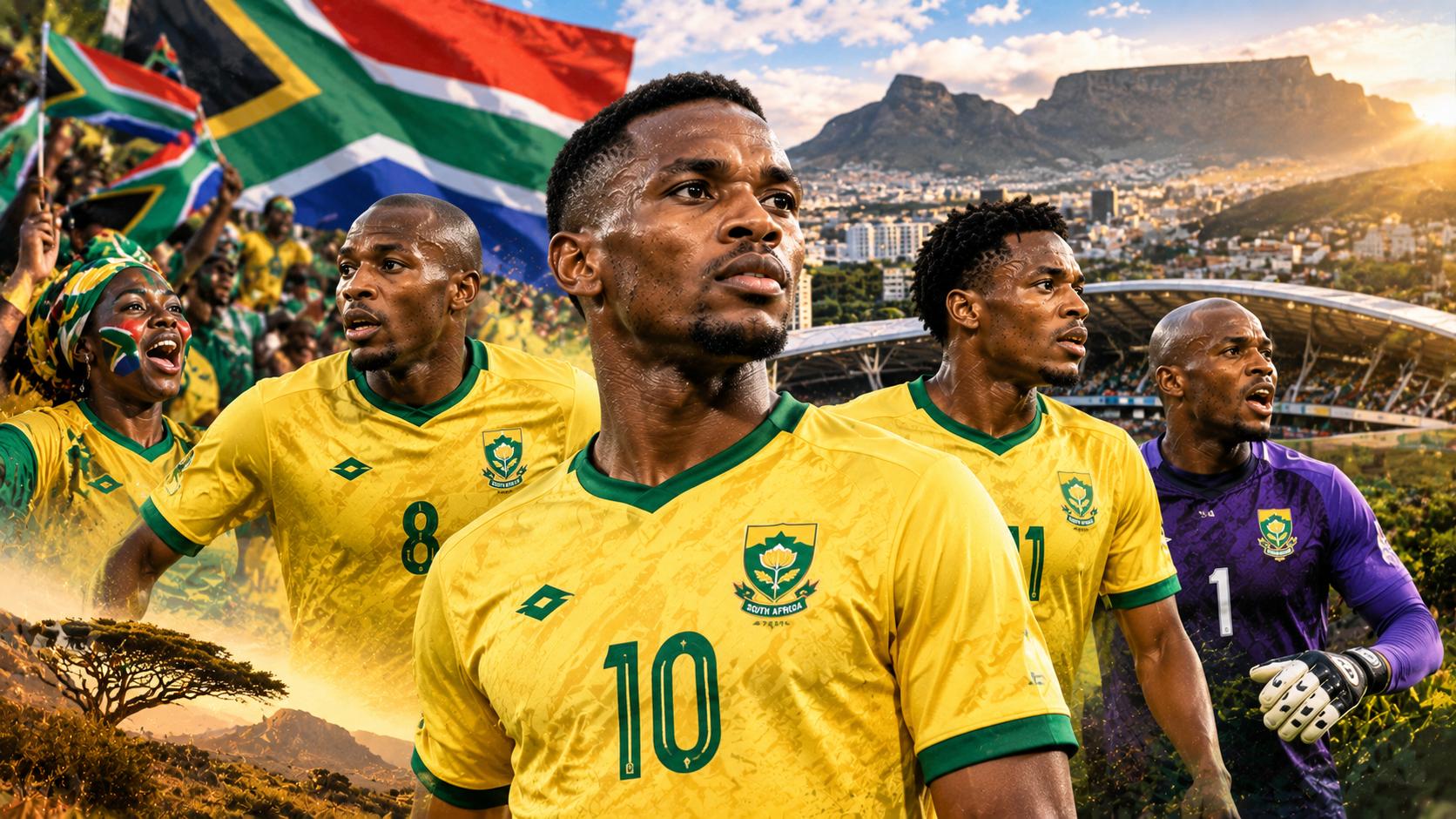
Bafana Bafana is the nickname of South Africa’s men’s national football team, a Zulu and Nguni phrase that roughly translates to “the boys, the boys” or, in the way most fans hear it, “go, boys, go.” It is one of African football’s most recognisable names, attached to a side that won a continental title on home soil and later became the first African nation to host a World Cup.
Key Takeaways
- Bafana Bafana is the nickname for South Africa’s men’s national team, meaning “the boys, the boys” in Zulu.
- The team only returned to international football in 1992 after apartheid-era isolation, then won AFCON just four years later on home soil in 1996.
- South Africa hosted the 2010 World Cup, becoming the first African country to do so, and later qualified for the 2026 tournament after a 16 year absence.
- Aaron Mokoena holds the appearance record with 107 caps, while Benni McCarthy remains the all time leading scorer with 31 goals.
- Pitso Mosimane took over as head coach in September 2026, succeeding Hugo Broos after the side’s 2026 World Cup campaign.
Where The Name Bafana Bafana Comes From
The nickname is built on repetition, a common device in Nguni languages used for emphasis and affection rather than literal doubling. “Bafana” means “boys,” and saying it twice turns a plain noun into something closer to a chant, the kind of thing supporters would shout from the terraces long before it became an official team identity.
It stuck for a reason. South African football needed a fresh public face in the early 1990s, once the team returned from decades of isolation, and a name born on the terraces gave fans something to rally around that had nothing to do with the sport’s segregated past.
A Name Born Out Of Isolation
South Africa’s football association was founded back in 1892, but the country spent nearly three decades locked out of international competition because of apartheid. FIFA suspended South Africa in 1976 and did not lift that ban until 1992, once a new, non-racial SAFA had been formed the year before.
The team’s first match back was a 1-0 win over Cameroon on 7 July 1992, a genuinely emotional occasion given how long South African players had been shut out of the global game. Bafana Bafana as a name and a team both effectively began their modern story in that moment.
What Bafana Bafana Have Actually Won
Isolation makes the next few years even more remarkable. Four years after returning to international football, South Africa hosted and won the 1996 Africa Cup of Nations, beating Tunisia 2-0 in the final in Johannesburg. It remains the country’s only AFCON title, though the side backed it up with a runner-up finish in 1998 and third-place finishes in 2000 and again in 2023.
Read More: South Africa at AFCON: The 1996 Title That Announced Bafana Bafana covers that tournament and its wider impact in full.
World Cup History, Including 2010 and 2026
South Africa has reached the men’s World Cup four times: 1998, 2002, 2010 and 2026. The 2010 edition is the one that matters most in the country’s football story, since South Africa became the first African nation ever to host the tournament. The team went out in the group stage despite a spirited 2-1 win over France, but the tournament itself changed how the continent was viewed as a footballing host.
Read More: South Africa 2010: The World Cup That Changed African Football Forever goes deeper into what that summer meant for the continent.
Sixteen years later, South Africa returned to the World Cup stage in 2026 and reached the round of 32 for the first time in the country’s history, a genuine marker of progress under Hugo Broos.
Records, Legends And The Players Who Defined The Team
Every national team has a handful of names that outsiders learn first, and for South Africa two stand well above the rest on the record sheet.
The Appearance And Goalscoring Records
Aaron Mokoena is South Africa’s most capped player with 107 appearances between 1999 and 2010, a run that included captaining the side at their home World Cup. Benni McCarthy holds the scoring record with 31 goals from 1997 to 2012, built on a club career good enough to win the UEFA Champions League with Porto in 2004.
Lucas Radebe belongs in the same conversation, not for the numbers but for what he came to represent both at Leeds United and as Bafana Bafana’s captain during the 1996 AFCON win. For a wider ranking, see our list of the greatest South African footballers of all time.
Read More: Lucas Radebe: The Leeds Legend Who Became a Nation’s Captain tells his story in full.
Biggest Results On Record
South Africa’s record win stands at 8-0 against Australia in Adelaide in 1955, a scoreline from long before the modern Bafana Bafana era but still the mark on the books. On the other end, an 9-1 defeat to England in Cape Town in 1920 remains the heaviest loss in the team’s history, another result from the pre-apartheid-ban period of South African football.
Kit, Grounds And Identity
Bafana Bafana play in green and gold, colours pulled from the national flag and worn with pride by a fanbase that treats international football as one of the few genuinely unifying spaces in South African life. There is no single national stadium the team calls home. Fixtures rotate between grounds including Soccer City in Soweto, which seats close to 95,000 and hosted the 2010 World Cup final, alongside Moses Mabhida Stadium in Durban, the Royal Bafokeng Stadium and others depending on the occasion.
That rotation reflects the size and football culture of the country itself. Domestic passion runs through club football just as much as the national side, something anyone new to South African football should understand before going further.
PSL Explained: A Guide to South Africa’s Premier Soccer League is the natural next stop for that context, alongside Kaizer Chiefs vs Orlando Pirates: Inside the Soweto Derby, which explains the rivalry that produces most of the country’s current internationals.
Where Bafana Bafana Stand Today
Pitso Mosimane, a domestic coaching legend in his own right, was confirmed as Bafana Bafana’s new head coach in September 2026, taking over from Hugo Broos after the team’s World Cup campaign in the summer. The appointment closes one era and opens another, with South Africa now looking to build on a return to the game’s biggest stage rather than simply chase qualification for it.
For the sport’s biggest tournament on home soil, South Africa’s own competition sits within the wider AFCON picture, where the team continues to be judged against Nigeria, Egypt and the rest of the continent’s traditional powers.
For a broader look at how that tournament works and what is coming next, the AFCON hub on TuSportNews tracks the competition itself, while the AFCON AI Predictions page covers upcoming fixtures as they are confirmed. For match forecasts across the sport more broadly, the AI Predictions hub is the place to start.
Bafana Bafana’s story is really the story of South African football finding its way back into the world game after being shut out of it, then slowly building something that a country of this size and football passion had always been capable of. A single AFCON title and one home World Cup are not a huge trophy haul by the standards of the continent’s very best, but few teams have had to rebuild an entire footballing identity from a standing start the way South Africa did after 1992.