In April 2023, AZ Alkmaar became the first Dutch club to win the UEFA Youth League, beating Hajduk Split 5-0 in the final. Weeks later, the senior side went out of the Europa Conference League semi-finals against West Ham United.
Both teams belong to the same system, and it explains how a club with a 19,500-seat stadium keeps punching above its weight in European competition. This guide covers how AZ train, from the facilities in Wijdewormer to goalkeeper work, academy pathways and the way the club approaches European nights. For the on-pitch side, see how AZ’s tactics have changed under each manager.
Key Takeaways
- AZ train in the Dutch tradition, working on technique, tactical understanding and physical conditioning together through small-sided games and positional play.
- The AFAS Training Complex, opened in summer 2016, is the single base for the first team, every youth side and the women’s team.
- Goalkeepers have their own pathway, shown by Rome-Jayden Owusu-Oduro’s climb from the under-12s to a first-team debut in December 2023.
- Players such as Teun Koopmeiners, Calvin Stengs and Adam Maher show how the academy turns young recruits into first-team regulars and, eventually, sales.
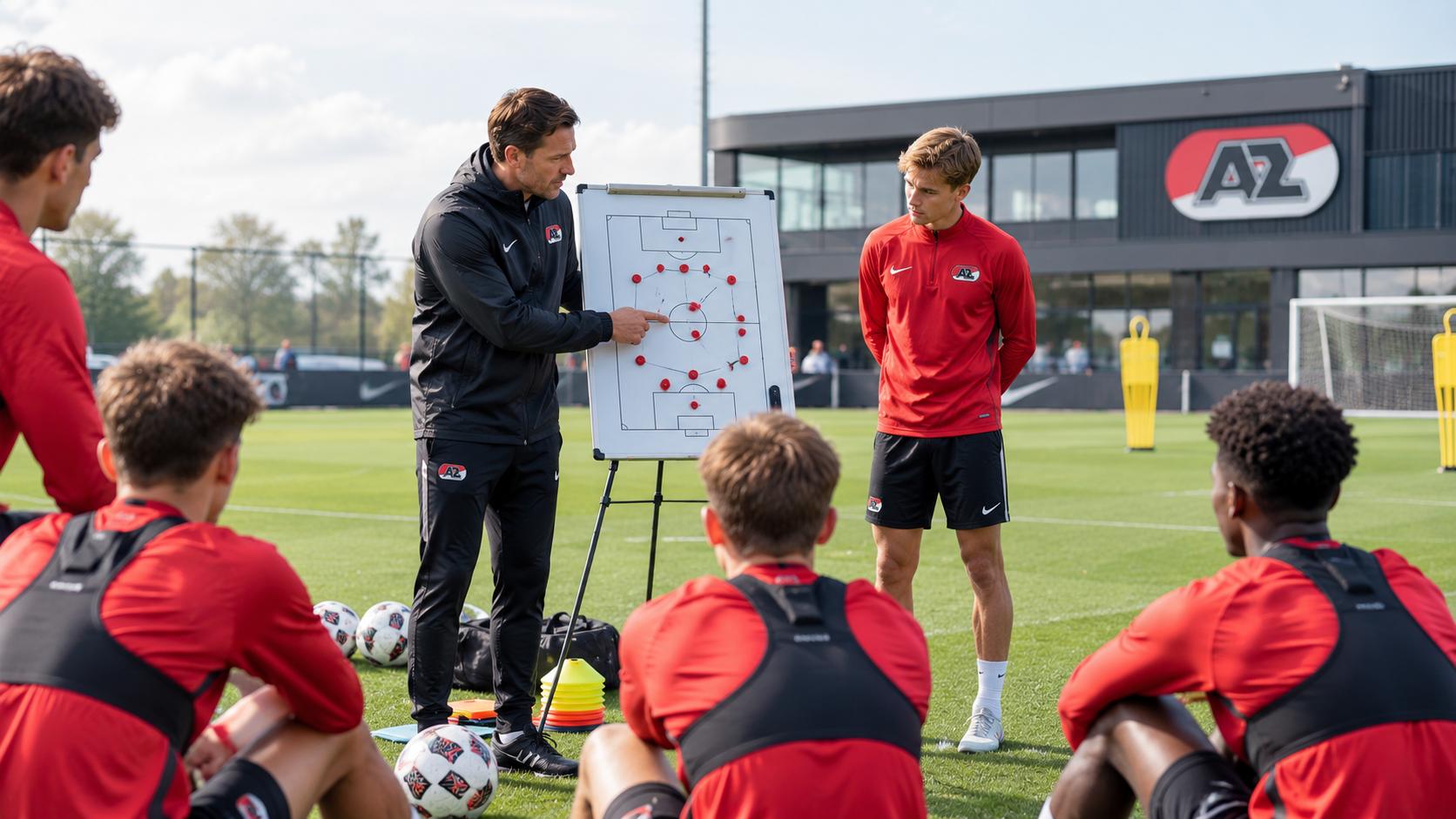
The Philosophy Behind AZ’s Training
AZ train inside the Dutch school of thought, where technique comes first and tactical insight follows. Ajax’s TIPS model, which stands for Technique, Insight, Personality and Speed, is the best-known version of that thinking. Position play and small-sided games sit at the centre of it.
AZ say their academy trains players on varied surfaces, and even rotates footwear and ball types, to develop the mind, technique and body together. The idea is simple: a player who copes with different conditions in training copes better when a match changes shape.
The results back the approach up. The academy won the Rinus Michels Award for the best youth academy in the Netherlands in both 2015 and 2016. In 2010 it scored 5,744 points in the KNVB’s academy certification, the highest total in the country at that point.
Inside the AFAS Training Complex
The AFAS Training Complex opened in Wijdewormer in summer 2016 and has natural grass and artificial turf pitches. A Nike Performance Playground, with artificial grass, sand and asphalt surfaces, was added a year later. There is also an indoor hall, a gym, physiotherapy and medical offices, and a Family Home dining area for the youth teams.
The technology is aimed at the brain as much as the body. The club uses virtual reality and IntelliGym, a cognitive training game, to sharpen decision-making, and Teqball tables for touch work. Wearable GPS trackers and heart-rate monitors are standard across professional football, so expect individual workloads to be managed with the same kind of data.
What a Typical Training Session Looks Like
AZ do not publish their session plans, so this is the general shape of a Dutch top-flight session rather than a minute-by-minute schedule. Each block has a job to do.
1. Warm-Up and Conditioning
Sessions open with dynamic stretching, agility drills and light ball work. The aim is to raise the heart rate and prepare joints for sharp changes of direction.
2. Technical Drills
Ball control, passing, dribbling and finishing come next, usually in patterns that copy match situations. For academy players, repetition of these basics is the foundation everything else sits on.
3. Tactical Work
Players rehearse formations, pressing triggers and attacking patterns. They also learn what each position demands, which is why Dutch academies move players around the pitch at a young age.
4. Small-Sided Games
Small-sided games compress space and time, so players make decisions faster and touch the ball more often. They are where technique meets tactics.
5. Set Pieces
Corners, free kicks and throw-ins get their own time, because close matches are often settled there. Attacking and defensive routines are both practised.
6. Cool-Down and Recovery
Static stretching and light exercise close the session, with massage and ice baths used to speed recovery and reduce injury risk.
Goalkeeper Development at AZ
Goalkeeper coaching in a Dutch academy covers shot-stopping, distribution and positioning. Keepers also learn to read the play and organise the defence in front of them. Their conditioning leans on agility, reflexes and endurance.
Rome-Jayden Owusu-Oduro is a clean example of the pathway. He started at DVC Buiksloot, then joined AZ’s academy around 2015 and began playing for the club at under-12 level. The AZ under-18 side won a league and cup double in 2021-22, and he spent 2022 to 2024 at Jong AZ, making 33 Eerste Divisie appearances.
He signed a professional contract through 2027-28 on 8 December 2023 and made his first-team debut in the Conference League against Legia Warsaw six days later. Owusu-Oduro also played in the 2025 KNVB Cup final, which AZ lost to Go Ahead Eagles on penalties.
From Youth Team to First Team
AZ run nine competitive squads, from Jong AZ in the Eerste Divisie down to under-11 level, and the under-19s play in the A-Junioren Eredivisie. Regular league matches matter as much as training. They teach players to make decisions under pressure and build the match fitness that drills cannot.
Adam Maher shows how long the process can take. He joined AZ’s academy in 2004 from AVV Zeeburgia, made his professional debut in December 2010 against BATE Borisov in the Europa League and scored. He played 66 times for the club across all competitions before moving to PSV Eindhoven in 2013.
The 2019-20 season shows the same pipeline working in bulk. AZ regularly started six or seven academy graduates, and Myron Boadu, Calvin Stengs, Teun Koopmeiners and Owen Wijndal were all recruited at 12. The squad’s average age was 23.7.
Tijjani Reijnders took a different route, arriving in AZ’s under-21 side in 2017 from CSV ’28 before reaching the first team in 2018. He left for AC Milan in July 2023 and joined Manchester City in June 2025. Moves like that explain why transfers are central to AZ’s model, which you can see in our guide to how football transfer fees actually work.
Read More: Loan Deals in Football Explained
Preparing for European Nights
European football asks different questions of a team, and AZ’s 2022-23 Conference League run is the best recent test. They beat Lazio 4-2 on aggregate in the round of 16, then met West Ham in the semi-finals. West Ham won the first leg 2-1 at the London Stadium on 11 May 2023, with Said Benrahma and Michail Antonio scoring.
The second leg, in Alkmaar a week later, finished 0-1 with Pablo Fornals scoring, which sent West Ham through 3-1 on aggregate. The AZ squad that night mixed academy products with signings such as Djordje Mihailovic, the USMNT midfielder who arrived from CF Montreal on 1 January 2023 and left for Colorado Rapids in January 2024.
The dugout changed soon afterwards. Pascal Jansen, who led the team through that European run, was dismissed on 17 January 2024, and Maarten Martens took over, extending his contract through summer 2028 in May 2025. Martens was himself dismissed on 18 January 2026 and replaced by Lee-Roy Echteld, but the pathway carried on through each change, with Owusu-Oduro playing in the 2025 KNVB Cup final under Martens.
How AZ Fit Into the Eredivisie
AZ have won the Eredivisie twice, in 1980-81 and 2008-09, and finished fourth in both 2022-23 and 2023-24 before a fifth-place finish in 2024-25. Those finishes describe a club that lives in the top five.
The Eredivisie league profile puts AZ in context against Ajax, PSV and Feyenoord, and the Eredivisie AI predictions page carries match-by-match forecasts for AZ’s league fixtures. For the other competitions we cover, the AI football predictions hub has every league in one place.
Why the AZ Pathway Keeps Working
The AZ model comes down to a few repeatable choices. Recruit talented players at 12, train them on varied surfaces, give them real league minutes at Jong AZ and in the under-19 Eredivisie, then sell the best at the right moment to fund the next group. Koopmeiners, Maher and Reijnders all followed that arc.
If you follow AZ, the most useful habit is watching beyond the first team. Check Jong AZ’s Eerste Divisie line-ups and the goalkeepers on the bench, because that is where the next European-night starter is usually sitting.