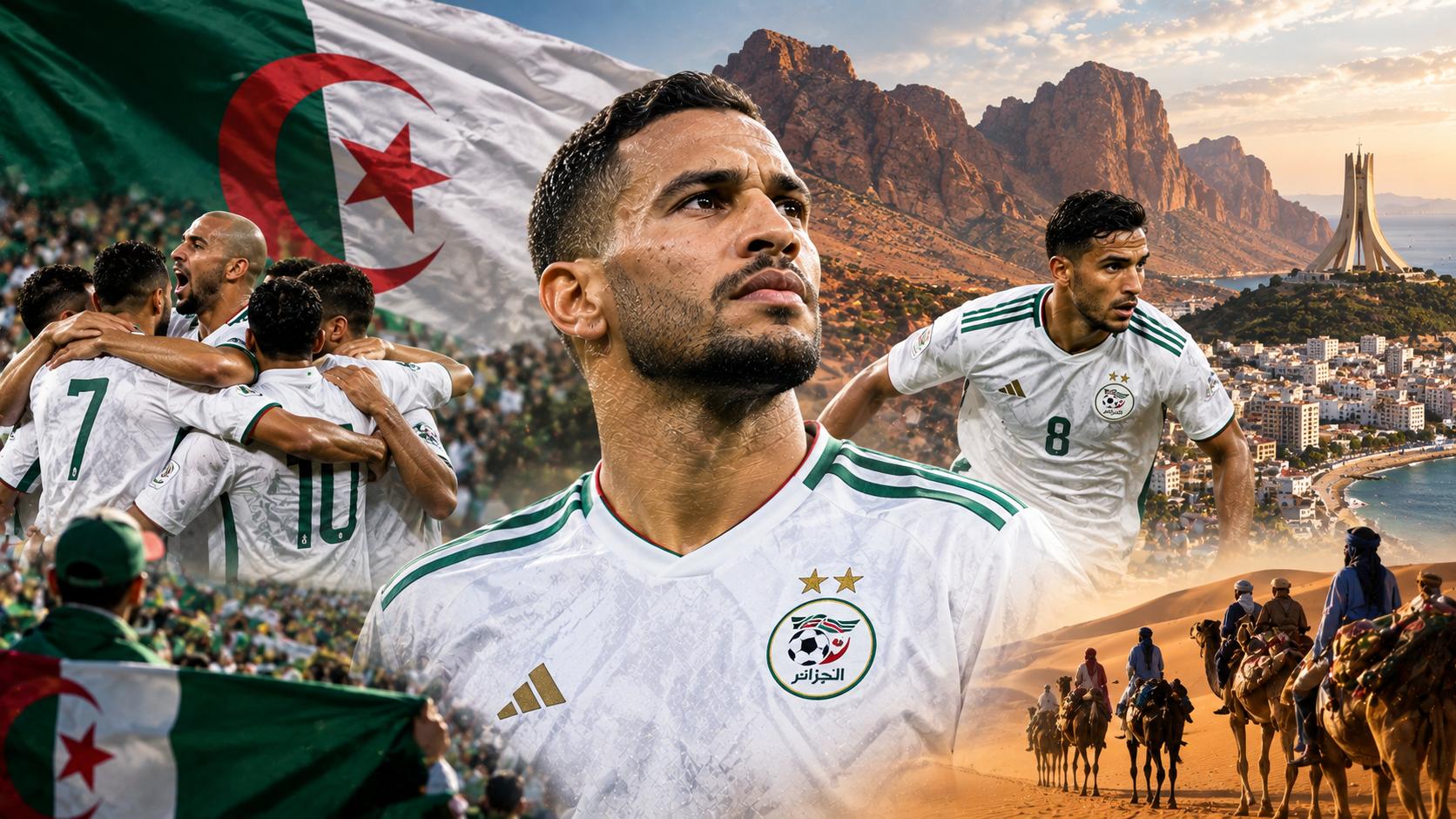
The Desert Foxes is the English rendering of Les Fennecs, the nickname Algeria’s men’s national football team carries in honour of the fennec fox, a small nocturnal animal native to the Sahara. The side is also known as Les Verts, “The Greens,” and has spent six decades building a reputation as one of Africa’s most dangerous teams to face, backed by two Africa Cup of Nations titles and a World Cup history full of genuine shocks.
Key Takeaways
- Algeria’s nickname, Les Fennecs, honours the fennec fox, a small desert animal native to the Sahara, while “Les Verts” (The Greens) is the team’s other common nickname.
- The team joined FIFA on 1 January 1964, roughly 18 months after Algeria’s independence from France.
- Algeria has won the Africa Cup of Nations twice, as hosts in 1990 and again in 2019 in Egypt.
- Islam Slimani is Algeria’s all time top scorer with 46 goals, while Aissa Mandi holds the appearance record with 123 caps.
- Riyad Mahrez closed out his international career as captain with 120 caps and 40 goals, retiring after the 2026 World Cup, and Brahim Hemdani took over as head coach the same year following Vladimir Petkovic’s departure.
Where The Desert Foxes Name Comes From
The fennec fox is instantly recognisable across North Africa for its oversized ears and its ability to survive in punishing desert heat, which made it a natural symbol for a national football team representing a country that is more than four fifths Sahara. The nickname has stuck internationally in a way few other African team nicknames have, giving Algeria one of the more distinctive identities in world football media coverage.
“Les Verts,” the other common nickname, refers simply to the green trim that has featured on Algeria’s kits since the team’s earliest years, worn alongside the white shirts that remain the side’s traditional home colour.
A Team Born Out Of Independence
The Algerian Football Federation was formed around the country’s independence from France in July 1962, and Algeria joined FIFA on 1 January 1964, barely eighteen months later. That timeline matters because it places Algerian football directly inside the story of a newly independent nation building its institutions from scratch, football included.
Read More: Algeria at AFCON: Two Titles and a Golden Generation covers how that early institution building eventually turned into continental silverware.
What The Desert Foxes Have Actually Won
Algeria’s first AFCON title came in 1990, won on home soil in front of their own supporters, a genuine landmark for a football federation barely three decades removed from its founding. The second arrived in 2019 in Egypt, when Algeria went through the entire tournament unbeaten under coach Djamel Belmadi, a run still regarded as one of the most complete AFCON campaigns any side has produced.
Read More: Algeria’s 2019 AFCON Triumph: Inside an Unbeaten Run to the Title breaks down that specific tournament match by match.
World Cup History And The Disgrace Of Gijon
Algeria has qualified for the World Cup five times, in 1982, 1986, 2010, 2014 and 2026, reaching the round of 16 in 2014, still the country’s best ever finish at the tournament. The 1982 edition is remembered for one of the most notorious moments in World Cup history: Algeria beat West Germany 2-1 in their opening game, only to be eliminated after West Germany and Austria played out a suspiciously convenient 1-0 result that sent both European sides through at Algeria’s expense.
That match, still referred to as the Disgrace of Gijon, was disturbing enough that FIFA changed World Cup scheduling afterward so that all final group-stage matches within a group are now played simultaneously, precisely to prevent a repeat.
Records, Captains And The Players Who Built The Reputation
Islam Slimani holds Algeria’s all time scoring record with 46 goals, a total built across a club career that took him through Sporting CP, Leicester City and Monaco among other stops. Aissa Mandi holds the appearance record with 123 caps, a defensive career built largely away from the spotlight compared to Algeria’s more famous attacking names.
Riyad Mahrez’s Record As Captain
Riyad Mahrez captained the national team to the end of his international career, retiring after Algeria’s 2026 World Cup exit with 120 caps and 40 goals, numbers built on top of a club career that turned him from a little known winger into one of the most decorated African players of his generation.
Read More: Riyad Mahrez: From Le Havre Reserves to African Footballer of the Year tells that story from the very beginning.
Brahim Hemdani, a former Marseille and Rangers midfielder, was appointed Algeria’s head coach in 2026 after Vladimir Petkovic departed following the team’s World Cup campaign. Hemdani arrived with a strong recent record, having led Algeria’s under-21 side to gold at the Mediterranean Games, the country’s first success at that event in 51 years.
Where Algeria Sit In African Football Today
Algeria were ranked 29th in the world as of July 2026, comfortably among the continent’s strongest sides alongside Morocco, Senegal and Nigeria. The rivalry with Morocco in particular has grown into one of the most closely followed fixtures anywhere on the continent, mixing genuine football quality with a political and historical backdrop few other derbies can match.
That relationship is covered in full in Algeria vs Morocco: Football, Politics and North Africa’s Fiercest Rivalry.
For upcoming Algeria fixtures and the wider tournament they continue to chase, the AFCON hub on TuSportNews and its AI Predictions page track the competition as it develops, while the broader AI Predictions hub covers match forecasts across every league TuSportNews currently follows.
A Nickname That Has Earned Its Reputation
Algeria’s football story runs from a newly independent federation joining FIFA in 1964 through to a genuinely golden generation that went unbeaten across an entire AFCON campaign in 2019. The Desert Foxes nickname might have started as a simple nod to a desert animal, but six decades of football have given it real substance behind it, a team that has embarrassed West Germany, gone unbeaten through Africa’s toughest tournament, and produced a Premier League and Champions League winner in Riyad Mahrez along the way.