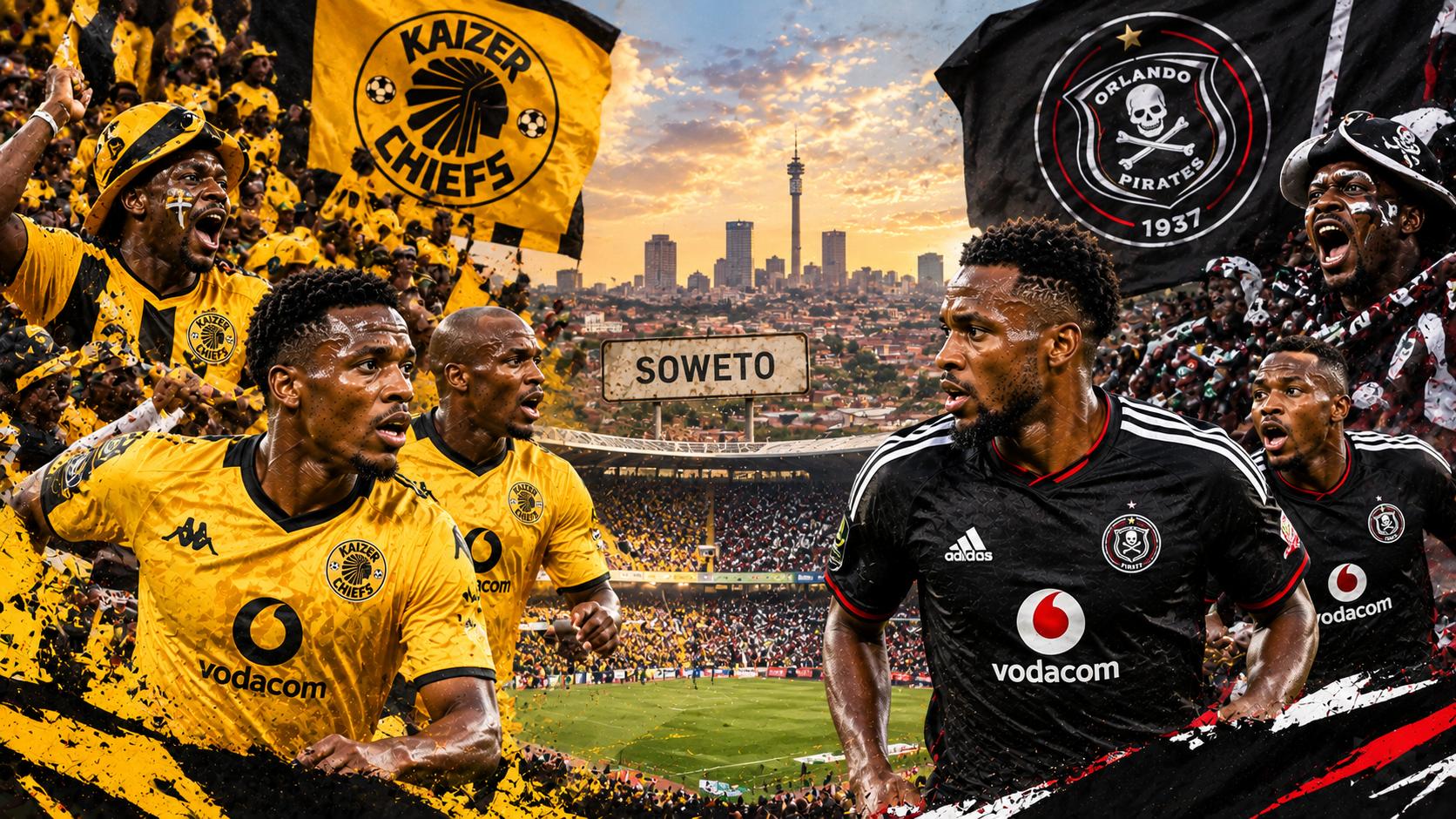
Every Soweto Derby carries a strange irony. Kaizer Chiefs, one of the two biggest clubs in South African football, exists only because its founder once played for Orlando Pirates and walked away from it. That single break in 1970 created the fixture that now fills a 90,000-seat stadium twice a year and decides bragging rights across an entire country.
Key Takeaways
- Kaizer Chiefs was founded in 1970 by Kaizer Motaung, a former Orlando Pirates player who left the club to form his own after returning from the North American Soccer League.
- Orlando Pirates, founded in 1937, remain the older and historically more decorated of the two clubs at continental level.
- Pirates lead the all time head to head, with 50 wins to Chiefs’ 37 across 107 meetings, with 20 draws.
- Derby matches regularly draw crowds above 90,000 at FNB Stadium, among the largest attendances for any club fixture in Africa.
Why A Former Pirate Started His Own Club
Kaizer Motaung was an Orlando Pirates player before leaving South Africa to join the Atlanta Chiefs in the North American Soccer League, where he became the league’s rookie of the year. When he returned home in 1970, internal tensions at Pirates convinced him not to go back. Instead, he formed his own side, borrowing both his own first name and the “Chiefs” part of his old American club’s name for the new team.
What started as a breakaway side quickly grew into one of South Africa’s two biggest clubs, and the fixture between Motaung’s new team and the club he had left became personal almost immediately. The first official meeting between the two came on 24 January 1970, a 1-0 win for Pirates that set the tone for everything that followed.
Read More: Who Are Bafana Bafana? South Africa’s National Football Team Explained has more on the national team both clubs have supplied generations of players to.
Orlando Pirates, The Older Half Of The Rivalry
Orlando Pirates were founded in 1937 as the Orlando Boys Club, taking their eventual name after a member suggested “Pirates” and the club adopted the war cry “Ezimnyama Ngenkani,” meaning “Black by Force.” By the time Chiefs came along in 1970, Pirates were already an established institution in Soweto, which is part of what made Motaung’s breakaway feel so significant.
Pirates’ Continental Breakthrough
Pirates hold one achievement Chiefs have never matched: becoming the first club from Southern Africa to win the African Cup of Champions Clubs, the forerunner to today’s CAF Champions League. They beat Ivory Coast’s ASEC Mimosas over two legs in December 1995, drawing 2-2 away before winning 1-0 at home for a 3-2 aggregate victory, a result celebrated widely enough that Nelson Mandela personally honoured the club afterward.
Read More: CAF Champions League Explained: Africa’s Biggest Club Competition covers how that competition has evolved since Pirates’ historic win.
The Numbers Behind The Rivalry
Across 107 official meetings, Orlando Pirates hold the head to head advantage with 50 wins to Kaizer Chiefs’ 37, with 20 matches drawn. Patrick “Ace” Ntsoelengoe, the Chiefs legend who also starred alongside Jomo Sono in the North American Soccer League, holds the record for most derby goals with 19.
The Biggest Scorelines
The largest winning margin in derby history belongs to Pirates, a 5-1 win over Chiefs in 1998 that remains the most one-sided result either side has produced in the fixture. More recently, the two clubs played out a 1-1 draw in April 2026, a reminder that even in quieter seasons neither club lets the other pull away easily.
Why The Derby Fills Stadiums Like Nothing Else
FNB Stadium, also known as Soccer City and the venue for the 2010 World Cup final, regularly hosts the derby and has recorded attendances above 92,000 for the fixture, among the highest for any club match anywhere on the continent. Orlando Stadium, Pirates’ home ground in Soweto itself, hosts the derby on a smaller but no less passionate scale when it is Pirates’ turn to host.
Read More: PSL Explained: A Guide to South Africa’s Premier Soccer League covers the wider competition both clubs play in, including the Carling Black Label Cup exhibition match the two sides now contest every pre-season purely because fan demand for the fixture never really goes away.
Colours, Nicknames And Fan Culture
Kaizer Chiefs play in gold and black and are known to supporters as Amakhosi, meaning “the Chiefs” or “the kings” in Zulu, while Orlando Pirates wear black and white and go by “the Buccaneers” or simply “Bucs,” a direct nod to their skull and crossbones badge. Both nicknames get chanted, printed on flags and worn on scarves across Soweto on derby day, and both fanbases treat the club identity as something closer to a family inheritance than a simple sporting preference.
That identity runs deep enough that support for one club over the other often follows family lines for generations, passed down the way a home town or a surname might be elsewhere. It is part of why the fixture still matters as much in years when neither club is challenging for the title as it does in years when the league itself is on the line.
What The Rivalry Means For South African Football
Neither club has been the PSL’s dominant force in recent years, with Mamelodi Sundowns’ run of eight straight titles only broken by Pirates’ 2025-26 championship, but the Soweto Derby remains the one fixture that can outdraw almost anything else in South African sport regardless of league position. It is a rivalry built on genuine history rather than manufactured hype, stretching from a personal falling out in 1970 to a modern fixture that still shuts down large parts of Johannesburg on matchday.
For South African football overall, this is the derby every other domestic rivalry gets measured against, and one of the clearest examples anywhere in Africa of how a single city can be split cleanly in two by the sport. The AI Predictions hub tracks upcoming fixtures and forecasts across the leagues TuSportNews currently covers, a useful companion for anyone following African football’s biggest club stories beyond the PSL itself.
Fifty five years on from that first meeting, the fixture that began with one man leaving his old club still decides bragging rights in Soweto every single season, and shows no sign of losing any of its edge.