On 11 February 2024 in Abidjan, William Troost-Ekong put Nigeria ahead in the 38th minute of the Africa Cup of Nations final. Franck Kessié levelled after the break, and Sébastien Haller scored the winner in the 81st minute for hosts Ivory Coast.
It was the fifth time Nigeria had lost an AFCON final, which is a record of near-misses that few teams can match. Set against three titles and a long list of podium finishes, it makes the Super Eagles one of the most interesting cases in the tournament’s history.
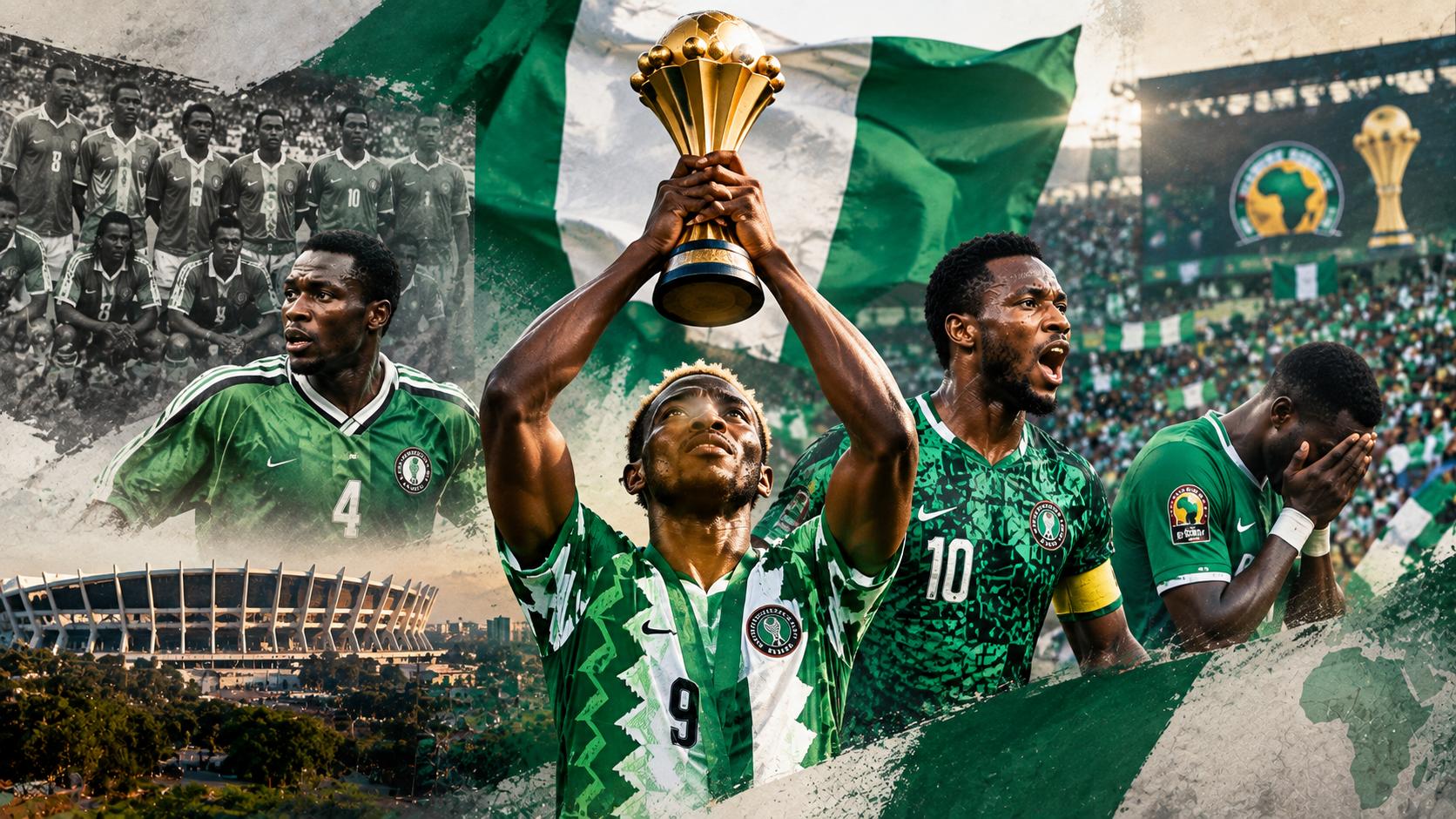
Key Takeaways
- Nigeria have won the Africa Cup of Nations three times, in 1980, 1994 and 2013.
- They have lost five finals, in 1984, 1988, 1990, 2000 and 2023, and finished third nine times.
- That adds up to 17 podium finishes, counting titles, runners-up and third places.
- Nigeria withdrew from the 1996 tournament as defending champions and were then banned from 1998.
- They finished third at the 2025 tournament in Morocco, and they now aim for AFCON 2027.
Nigeria’s AFCON Record at a Glance
Nigeria first played at the tournament in 1963, and their results since then are unusually consistent at the top end. Three titles, five runners-up finishes and nine third-place finishes give them 17 podiums.
The gaps are just as revealing. They did not qualify in 1968, 1972, 1986, 2012 and 2015, and they withdrew or were banned from several editions in between.
| Result | Years |
|---|---|
| Champions (3) | 1980, 1994, 2013 |
| Runners-up (5) | 1984, 1988, 1990, 2000, 2023 |
| Third place (9) | 1976, 1978, 1992, 2002, 2004, 2006, 2010, 2019, 2025 |
The Three Titles
Each championship came in a different setting and with a different sort of team. Nigeria have won them at home, in North Africa and in southern Africa.
1. Lagos 1980
Nigeria hosted the tournament in 1980 and beat Algeria 3-0 in the final on 22 March at Surulere Stadium in Lagos, with 85,000 in attendance. It was their first title.
Christian Chukwu was named the best player of the tournament, and Segun Odegbami shared the top-scorer award with three goals.
2. Tunis 1994
The 1994 team beat Zambia 2-1 in the final on 10 April at El Menzah Stadium in Tunis. Zambia had rebuilt their squad after an air disaster that killed 18 players and several staff members, so the match carried an emotional weight that went beyond the trophy.
Nigeria’s second title came alongside a group that included Rashidi Yekini, Emmanuel Amunike and Stephen Keshi. Nigeria made their World Cup debut later that same year.
3. Johannesburg 2013
Keshi was the head coach in 2013, and Nigeria beat Burkina Faso 1-0 at the FNB Stadium in Johannesburg on 10 February. Sunday Mba scored the only goal in the 40th minute, and John Obi Mikel was named Man of the Match.
Nigeria had beaten Ivory Coast 2-1 in the quarter-final and Mali 4-1 in the semi-final on the way. Keshi became one of only two men to win the tournament as both player and coach.
The Five Lost Finals
The trophy cabinet tells only half the story. Nigeria have lost five finals, and the manner of the losses is what fans remember most.
| Year | Result | Venue |
|---|---|---|
| 1984 | Cameroon 3-1 Nigeria | Abidjan |
| 1988 | Cameroon 1-0 Nigeria | Casablanca |
| 1990 | Algeria 1-0 Nigeria | Algiers |
| 2000 | Cameroon 2-2 Nigeria, Cameroon won 4-3 on penalties | Lagos |
| 2023 | Ivory Coast 2-1 Nigeria | Abidjan |
Hosts won two of them, in 1990 and 2023, and the 2000 final was played on Nigerian soil in Lagos, which is why that shoot-out hurts most. Cameroon were responsible for three of the five losses.
The 2023 defeat was the most recent. Nigeria had reached the final by beating Angola 1-0 in the quarter-final and South Africa on penalties in the semi-final, then took the lead in Abidjan before Ivory Coast came back.
Why So Many Third-Place Finishes?
Nine bronze medals is the surprise in the record. Nigeria finished third in 2002, 2004 and 2006 in three successive tournaments, then again in 2010, 2019 and 2025.
The pattern suggests a team that regularly reaches the last four but finds the semi-final the hardest hurdle. In 2025 in Morocco they lost that stage on penalties before winning the third-place match against Egypt in a shoot-out of their own.
The 2025 Run in Morocco
The most recent edition showed the team at its best for long stretches. Nigeria won their group with three wins, then beat Mozambique 4-0 and Algeria 2-0 in the knockout rounds.
Morocco stopped them in the semi-final on penalties. Nigeria then beat Egypt in a shoot-out for third place, which made 2025 the ninth time the Super Eagles took a bronze medal.
The Gaps and the Bad Tournaments
Not every edition went well. Nigeria withdrew from the 1996 tournament as the reigning champions and were banned from the 1998 edition as a result.
The later years produced a few disappointments as well. They lost in the 2008 quarter-finals to hosts Ghana, went out in the 2021 round of 16 (played in January 2022) and did not qualify at all in 2012 or 2015.
Those gaps explain why the trophy count is not higher. A team with this much talent should have more than three titles, and the missing editions are a large part of the reason.
What Comes Next for Nigeria at AFCON
The next target is AFCON 2027, which Kenya, Tanzania and Uganda will co-host. Nigeria have been drawn in Group L of qualifying against Madagascar, Guinea-Bissau and Tanzania, and our AFCON 2027 qualifiers guide lists all the groups and fixtures.
For the bigger picture on the tournament itself, our complete guide to AFCON 2027 explains the host cities and format. The full African football calendar for 2027 shows where the finals sit among the year’s other tournaments.
Why Nigeria Still Chase a Fourth Title
Nigeria’s record is closer to a heavyweight’s than the three titles suggest. Seventeen podium finishes and five lost finals show a team that is almost always in the conversation.
The missing piece is a fourth title. If Nigeria qualify for 2027, watch how they handle the semi-final, because that is where their 2025 run ended.