Alpha Onyango’s 83rd-minute goal on 26 April 2026 was the only one at Nyayo National Stadium, and it was enough to send Gor Mahia six points clear at the top of the Kenyan league. The crowd was reported to be well beyond the ground’s official capacity of 18,000, and more than 500 police officers had been deployed before kick-off.
That is the Mashemeji Derby on a Sunday afternoon in Nairobi. Two clubs, one city, and a rivalry that has run since 1968.
Last updated: 19 October 2026.
Key Takeaways
- The Mashemeji Derby is the fixture between Gor Mahia and AFC Leopards, and “Mashemeji” is Kiswahili for “in-laws.”
- The first meeting took place on 5 May 1968, and after 99 derbies Gor Mahia have 35 wins, AFC Leopards 29 and 35 games have ended level.
- Gor Mahia have won a record 22 league titles, the latest in 2025/26, while AFC Leopards have 12 and last won the league in 1998.
- Gor Mahia’s support is largely Luo and Leopards’ support is largely Luhya, which gives the fixture a cultural undertone.
- Gor Mahia are the only Kenyan club to have won a CAF title, the 1987 African Cup Winners’ Cup.
What Does Mashemeji Mean in Kenyan Football?
Mashemeji is Kiswahili for “in-laws,” and the name points to the long-standing ties between the Luo and Luhya communities. Gor Mahia’s support is mostly Luo, AFC Leopards’ support is mostly Luhya, and marriage between the two groups has been common for generations.
The label is younger than the rivalry. Match reports in the 1970s and 1980s called these games “The Big Clash,” and the Mashemeji name took hold in July 2011, when Nation Media coverage helped popularise a joke that fans were already trading on social media.
Where the Rivalry Comes From
Both clubs were founded within a few years of each other by Kenyans from the west of the country who had moved to Nairobi. Each became a way for a community to see itself represented in the capital.
1. Gor Mahia
Gor Mahia was founded on 17 February 1968 through a merger of Luo Union and Luo Sports Club. The name comes from a legendary medicine man from Kanyamwa in Homa Bay County, whose nickname meant “magic” in Dholuo.
The club goes by K’Ogalo, and supporters use match days to express cultural and political identity as much as club loyalty. On the pitch the record is hard to argue with: 22 Kenyan league titles and the 1987 African Cup Winners’ Cup, which no other Kenyan side has matched.
2. AFC Leopards
AFC Leopards began on 12 March 1964 as Abaluhya Football Club and dropped the ethnic name for AFC Leopards around 1980, after clubs were told to move away from tribal identities. The nickname is Ingwe, and the club has 12 league titles, the most recent in 1998.
Leopards were relegated from the top flight in the 2000s and returned in 2009, and financial problems have followed them for years. The club’s history is bigger than its recent results, which is why a derby win carries so much weight for its supporters.
| Gor Mahia | AFC Leopards | |
|---|---|---|
| Founded | 1968 | 1964 (as Abaluhya FC) |
| Nickname | K’Ogalo | Ingwe |
| League titles | 22 | 12 |
| Last league title | 2025/26 | 1998 |
| Main support base | Luo | Luhya |
Tribe, Politics and Identity
The rivalry is not only about football. Gor Mahia were created through a merger of Luo Union and Luo Sports Club, and politicians Tom Mboya and Jaramogi Oginga Odinga were among the early figures behind the club. AFC Leopards were formed in 1964 when Nairobi clubs such as Marama, Samia United and Bunyore merged with several lower-division sides to give the Luhya community a team in the capital.
Both clubs were later pushed to drop ethnic names. Leopards moved from Abaluhya to the neutral name AFC Leopards, while Gor Mahia kept their name after President Daniel arap Moi’s order against tribal club names, and Luo Union’s football side went back to the name Reunion FC. Fans on both sides still see their club through the old lens.
Politicians have stayed close to both clubs. Musalia Mudavadi, Moses Mudavadi, Martin Shikuku, Alfred Sambu and Cyrus Jirongo are among the patrons associated with Leopards, and the derby has at times reflected wider political rivalries in western Kenya and Nairobi.
Two Clubs, Two Different Stories Off the Pitch
- Gor Mahia: Fans nicknamed the club “Sirkal,” meaning government. In 2012 the Gor Mahia Fans Foundation launched to give supporters a voice in club governance, a youth system and fundraising.
- AFC Leopards: Money has been the club’s longest-running problem. In 2020 the club was described as financially crippled, and in 2024 politicians backed plans to corporatise it and bring in wider investment. The club owns a 20-acre parcel in Kasarani, earmarked for a permanent stadium complex.
Honours Compared
| Gor Mahia | AFC Leopards | |
|---|---|---|
| Kenyan league titles | 22 | 12 |
| Years of league titles | Latest: 2022/23, 2023/24, 2025/26 | 1966, 1967, 1970, 1973, 1980, 1981, 1982, 1986, 1988, 1989, 1992, 1998 |
| Continental | 1987 African Cup Winners’ Cup | No CAF title |
| Main home ground | Nairobi stadiums, shared with other clubs | Nyayo National Stadium (18,000) |
Leopards also have a strong regional record, with five CECAFA Club Cup titles (1979, 1982, 1983, 1984 and 1997).
How They Finished in 2025/26
| Club | Position | P | W | D | L | GF | GA | Pts |
|---|---|---|---|---|---|---|---|---|
| Gor Mahia | 1st | 34 | 20 | 9 | 5 | 50 | 22 | 69 |
| AFC Leopards | 2nd | 34 | 19 | 7 | 8 | 44 | 28 | 64 |
With the two clubs finishing first and second, both derbies carried real weight in the title race.
Gor Mahia vs AFC Leopards Head-to-Head Record
Over 99 meetings the fixture has been close. Gor Mahia lead with 35 wins to AFC Leopards’ 29, but the 35 draws show how often neither side can break the other down.
Gor Mahia’s biggest derby win is a 5-1 in 1975, and Laban Otieno’s hat-trick that year is the only one in the fixture’s records. AFC Leopards’ biggest win is a 3-0 in 2011. Gor Mahia also hold the longest winning run, with seven in a row.
Goals do not come easily. Before the 99th meeting, Gor Mahia had scored 91 goals across 98 games and AFC Leopards 82, fewer than one per match for each side. The last two derbies were both 1-0 results.
Notable Mashemeji Derby Results
| Date | Result | Why it is remembered |
|---|---|---|
| 5 May 1968 | First meeting | The start of Kenya’s oldest club rivalry |
| 22 Feb 1975 | Gor Mahia 5-1 AFC Leopards | The first derby with more than two goals for one side, and Laban Otieno’s hat-trick, the only one in the fixture |
| 2 Aug 1986 | Gor Mahia 2-3 AFC Leopards | A high-scoring Leopards win at the City Stadium |
| 1 Feb 2003 | Gor Mahia 2-3 AFC Leopards | Another 3-2 Leopards win |
| 28 Feb 2009 | Gor Mahia 3-2 AFC Leopards | A Kasarani thriller |
| 10 Nov 2019 | Gor Mahia 4-1 AFC Leopards | Gor Mahia’s fifth derby win in a row |
| 2 Jun 2025 | 1-1 draw | The first Mashemeji Derby played outside Nairobi, at Raila Odinga Stadium in Homa Bay |
| 7 Dec 2025 | AFC Leopards 1-0 Gor Mahia | The 98th derby, and Leopards’ first win over Gor Mahia since June 2023 |
| 26 Apr 2026 | Gor Mahia 1-0 AFC Leopards | The 99th derby, with Alpha Onyango’s late winner |
Not every fan agrees on the details, because older records are patchy, but the pattern is clear: low scores are normal, and the rare goal-fest sticks in the memory. One long-running piece of terrace folklore says that once Sammy Onyango scored for Gor Mahia in the derby, no one else would score for them in the same match. There is no evidence to confirm it, but it is still repeated.
Derbies That Shaped the Rivalry
Some meetings are remembered for the football, and others for what happened around them. Three stand out from recent years.
- 7 December 2025: AFC Leopards 1-0 Gor Mahia. Julius Masaba scored in the 28th minute, ending Gor Mahia’s two-year run without a derby defeat. Coach Charles Akonnor admitted his side were “second best on the day.”
- 26 April 2026: Gor Mahia 1-0 AFC Leopards. The 99th derby, played with the title race live and Gor Mahia only three points ahead before kick-off.
- 2012: Riots followed Ali Abondo’s red card, and Gor Mahia were banned from stadium facilities afterwards.
The 2026 title race shows why the fixture matters beyond bragging rights. Leopards were second on 55 points before the April derby, and the defeat left them six points adrift with five matches left. Gor Mahia were crowned champions on 31 May 2026.
When the Derby Turned Ugly: Violence and Bans
The passion that fills the stands has also caused some of the most damaging episodes in Kenyan football. These are the best-documented incidents.
- Heroes’ Day 2011 (FKL Cup quarter-final): Moses Odhiambo headed Gor Mahia in front from a Moses Otieno free kick. Leopards fans then pelted the linesmen, the match was abandoned, and Leopards forfeited. The 1-0 scoreline stood, and Gor Mahia went on to win the cup by beating Sofapaka in the final.
- 23 March 2012: Gor Mahia midfielder Ali Abondo was sent off for a dangerous tackle on Amon Muchiri, and Gor Mahia fans rioted. The Sports Stadia Management Board banned Gor Mahia from Nyayo National Stadium and Kasarani for the rest of the 2012 season, which forced the postponement of a Top 8 Cup derby.
- 2013: Away from the derby, Gor Mahia fans invaded the pitch after a President’s Cup semi-final win over Sony Sugar and attacked players, and goalkeeper Wycliffe Kasaya was taken to hospital.
- 2014: Leopards fans invaded the pitch against Thika United with their side trailing 1-0 in the 85th minute. The league awarded Thika a 2-0 win and fined Leopards KSh 500,000.
Both sets of supporters have been involved, though Gor Mahia fans have more often been on the wrong side of the disciplinary record. The heavy police presence at modern derbies, including the 500 officers deployed in April 2026, is the legacy of those years.
Players Who Defined the Rivalry
- Sammy “Jogoo” Onyango: Gor Mahia’s all-time top scorer with 92 goals in all competitions, 79 of them in the league, between 1981 and 1989.
- Allan Thigo: A playmaker who scored 88 career goals for Gor Mahia and also coached the 1976 team.
- Hesbon Omollo: Scored 84 career goals and netted the injury-time winner in the first Moi Golden Cup final.
- Laban Otieno: The only man to score a hat-trick in the derby, in the 5-1 win in 1975.
- Peter Otieno Bassanga: Captained Gor Mahia in 1983, the year the title was settled in a 1-0 derby win.
The derby also sits close to the story of Kenya’s best-known export. Victor Wanyama’s father, Noah Wanyama, played for AFC Leopards in the 1980s, and Victor himself spent time in the Leopards youth system before heading to Europe. Our profile of Victor Wanyama tells the full story.
Where the Derby Is Played
Most recent Mashemeji Derbies have been staged at Nyayo National Stadium in Nairobi, which holds around 18,000. Older games were played at the City Stadium, including the 1975 and 1986 matches, and Kasarani has hosted the fixture too. The June 2025 derby broke new ground by moving outside the capital for the first time, to Raila Odinga Stadium in Homa Bay, in a county closely linked to Gor Mahia’s roots.
Fixtures can also be moved at short notice. The 98th derby was originally set for 29 November 2025 and had to be rescheduled to 7 December because the stadium was unavailable.
What a Mashemeji Derby Day Feels Like
Matches are usually staged at Nyayo National Stadium or Kasarani. Tickets for the April 2026 derby cost KES 300 on the terraces and KES 1,000 for VIP seats, a price range that keeps the game accessible and helps explain the overflowing crowd.
Security is a fixed part of the day. Police deployments in the hundreds are now standard for high-stakes derbies, a response to crowd trouble that has affected earlier editions. For a wider look at why these games get so heated, our piece on what makes a football rivalry covers the psychology behind it.
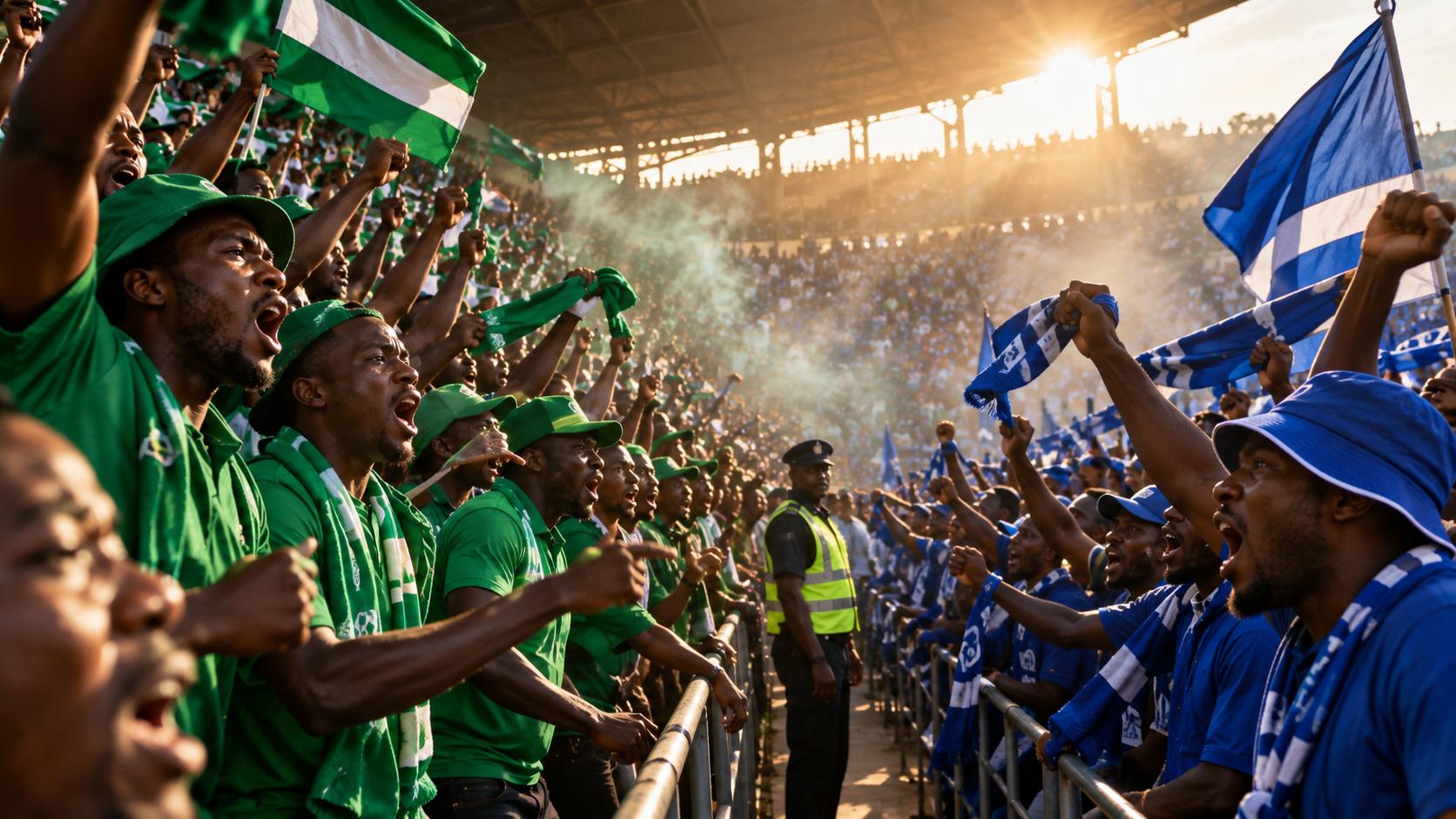
The supporters are the main event. Green on one side, blue on the other, songs starting long before kick-off, and plenty of good-natured banter between families who support opposite teams.
Why the Derby Matters for Kenyan Football
The fixture puts the two biggest fanbases in the domestic game into one stadium, and it draws attention to a league that gets far less coverage than the English or Spanish ones. Our Kenyan Premier League guide explains how the wider competition works.
The champion also earns a place in continental competition. If you want to see what that involves, our explainer on the CAF Champions League covers the format, and Gor Mahia have entered it 13 times.
The national team benefits as well. Gor Mahia supplied more players than any other club in the Harambee Stars’ September 2026 squad, and our profile of who the Harambee Stars are explains where those players fit.
Mashemeji Derby FAQ
What does Mashemeji mean?
It is Kiswahili for “in-laws.” The name reflects the many marriages between the Luo and Luhya communities, whose supporters make up most of the two fanbases. The derby is also known as the Ingo-Dala derby, and fans call the clubs Ingwe (Leopards) and K’Ogalo (Gor Mahia).
When was the first Mashemeji Derby?
The two clubs first met on 5 May 1968, which makes it the oldest rivalry in Kenyan football.
Who has won more Mashemeji Derbies?
Gor Mahia. After 99 meetings, they have 35 wins to AFC Leopards’ 29, with 35 draws.
Who is the bigger club, Gor Mahia or AFC Leopards?
By trophies, Gor Mahia. They have won a record 22 league titles to Leopards’ 12, and they are the only Kenyan club to win a CAF competition, the 1987 African Cup Winners’ Cup. Leopards won six league titles in the 1980s, though, and their last league title came in 1998.
What was the score in the last Mashemeji Derby?
Gor Mahia beat AFC Leopards 1-0 on 26 April 2026, with a goal from Alpha Onyango in the 83rd minute.
Has anyone scored a hat-trick in the derby?
Only once. Laban Otieno scored three for Gor Mahia in a 5-1 win in 1975.
Where is the Mashemeji Derby played?
Usually in Nairobi at Nyayo National Stadium, with Kasarani and the City Stadium used in the past. In June 2025 the fixture was played outside Nairobi for the first time, at Raila Odinga Stadium in Homa Bay.
Why is the derby so tense?
The clubs represent different communities, politicians have been closely involved with both, and the fixture has a history of crowd trouble, including the 2011 abandonment and the 2012 riot that led to a stadium ban.
Why Mashemeji Will Keep Drawing Crowds
We would argue few African derbies combine this much history, this tight a record and this much cultural weight in a single match. Gor Mahia are the more decorated club by some distance, yet AFC Leopards are close enough in the head-to-head that neither side ever walks in comfortable.
The next time the two meet, expect a full stadium, a heavy police presence and a scoreline that could go either way. If you want to see Kenyan football at its loudest, pick the derby, and pick the one with a title race attached.