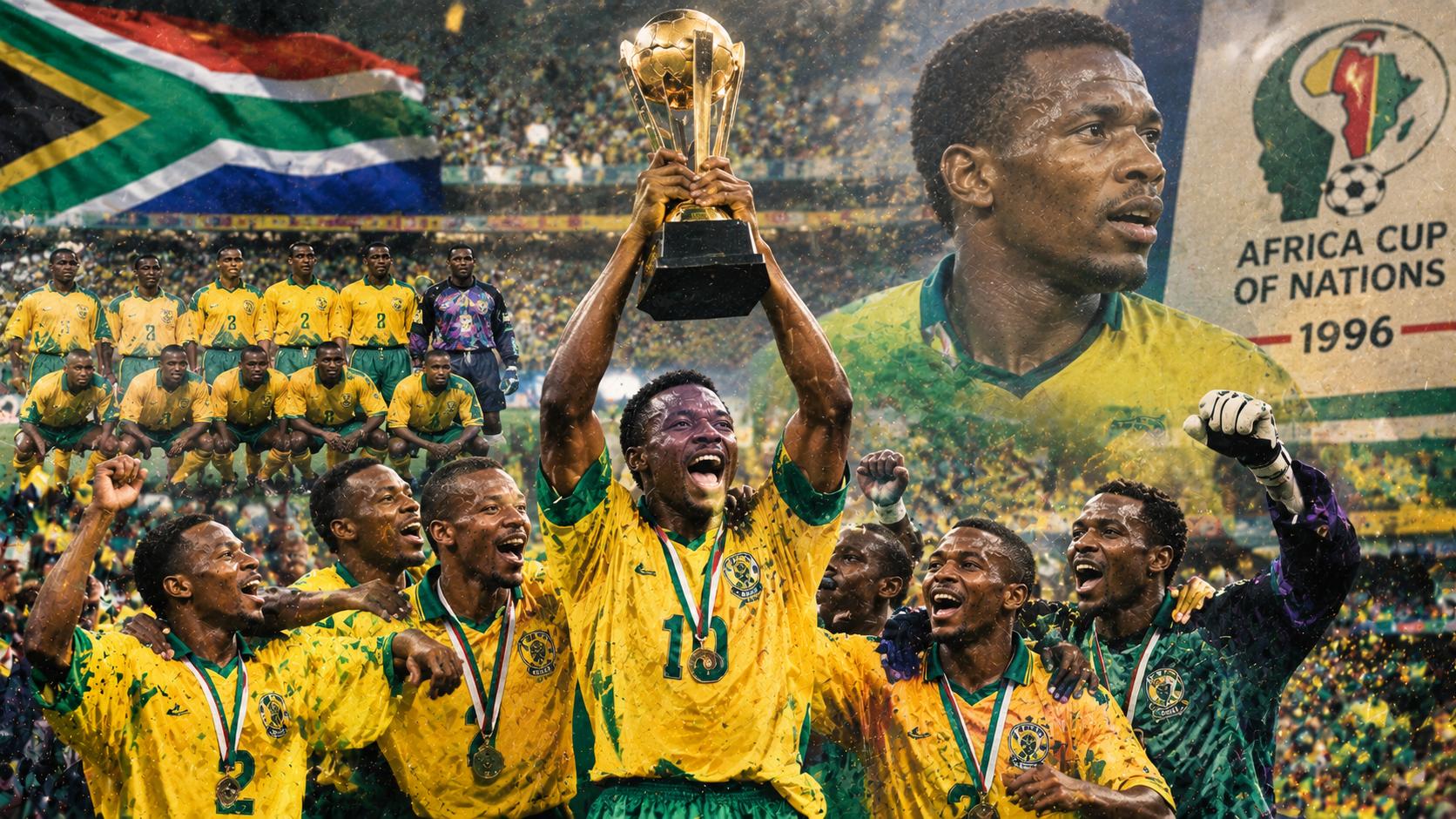
Mark Williams was sitting on the bench when South Africa walked out at FNB Stadium to face Tunisia in the 1996 Africa Cup of Nations final. By the final whistle he had scored both goals in a 2-0 win, delivered as a second-half substitute, in a match Nelson Mandela watched from the stands less than two years into his presidency. It remains South Africa’s only AFCON title, and arguably the single most important football result in the country’s history.
Key Takeaways
- South Africa hosted and won the 1996 AFCON, beating Tunisia 2-0 in the final at FNB Stadium on 3 February 1996.
- Substitute Mark Williams scored both of South Africa’s goals in the final, four years after the country’s return to international football.
- Nigeria withdrew from the tournament under political pressure from the Abacha regime, reducing the field from 16 teams to 15.
- Zambia’s Kalusha Bwalya was named the tournament’s best player after finishing as top scorer with 5 goals.
- The win came just four years after South Africa’s readmission to FIFA following the end of apartheid.
A Tournament South Africa Was Never Supposed To Win This Fast
South Africa had only returned to international football in 1992, so hosting and winning AFCON just four years later was never really part of anyone’s realistic plan. The tournament ran from 13 January to 3 February 1996 across four South African cities: Johannesburg, Durban, Bloemfontein and Port Elizabeth, with matches split between FNB Stadium, Kings Park, Free State Stadium and the old EPRU Stadium.
Sixteen teams were originally scheduled to compete, but Nigeria withdrew at the last moment under pressure from the Sani Abacha regime, cutting the field to 15 and voiding Nigeria’s three group matches entirely. That absence removed one of the continent’s strongest sides from the draw, though South Africa still had to beat the teams that were actually on the pitch.
Read More: Who Are Bafana Bafana? South Africa’s National Football Team Explained covers the wider story of the national team’s return from isolation that made this tournament possible in the first place.
How South Africa Reached The Final
South Africa won two of their three Group A matches, scoring 4 goals and conceding just 1, enough to advance comfortably into the knockout stage. The performance that really announced the host nation’s intent came in the semi-final, a 3-0 demolition of Ghana on 31 January 1996 that left little doubt South Africa belonged in the final.
The Final Against Tunisia
The final itself, played on 3 February 1996 in front of 80,000 fans at FNB Stadium, stayed scoreless deep into the second half before Mark Williams changed everything. Brought on as a substitute, Williams scored twice in quick succession to turn a tense, goalless final into a comfortable 2-0 win, sealing South Africa’s first ever continental title.
Nelson Mandela, then less than two years into his presidency, watched the win from the stands alongside deputy president F.W. de Klerk and sport minister Steve Tshwete. When captain Neil Tovey lifted the trophy in front of a genuinely multiracial crowd, the moment carried weight far beyond the scoreline.
Read More: Lucas Radebe: The Leeds Legend Who Became a Nation’s Captain looks at how Radebe’s leadership fit into that same squad and era.
The Individual Story Behind The Trophy
Zambia’s Kalusha Bwalya finished the tournament as top scorer with 5 goals and was named the competition’s best player, a reminder that South Africa’s title came against a genuinely strong field rather than a weakened one. Beating a tournament that produced a player of Bwalya’s quality made the achievement harder, not easier, and gave the win more credibility across the continent than a walkover would have.
South Africa’s own squad blended established domestic names like Doctor Khumalo with defenders such as Lucas Radebe and Mark Fish, both of whom went on to build careers in England on the back of the exposure this tournament gave them.
Why This Title Still Matters Three Decades Later
South Africa has never won another AFCON since 1996, finishing runner-up in 1998 and third in 2000 and 2023, which only adds weight to how singular this achievement remains. Winning a continental title four years after re-entering world football, on home soil, in front of the country’s first democratically elected president, is the kind of story that does not repeat itself easily.
Read More: PSL Explained: A Guide to South Africa’s Premier Soccer League covers the domestic league that was born the same year as this triumph, itself a product of the same post-apartheid football reorganisation.
For a wider look at how the tournament has evolved since, the AFCON hub on TuSportNews tracks the competition’s history and current edition, while the AFCON AI Predictions page covers upcoming fixtures as they get confirmed. The broader AI Predictions hub covers match forecasts across every league TuSportNews currently follows.
A Trophy That Reached Beyond Sport
South Africa in early 1996 was barely two years removed from its first democratic election, still working through the practical business of building a single national identity out of a country that had been legally and socially divided along racial lines for decades. Sport had been one of the clearest fault lines during apartheid, with rugby and cricket long associated with the white minority and football carrying deep support across Black, coloured and Indian communities.
A national football team winning a major trophy in that specific moment, in stadiums that had themselves only recently opened up to genuinely mixed crowds, gave the country a rare shared reference point. It did not erase decades of division on its own, but it gave millions of South Africans, across every community, the same thing to celebrate on the same night, which was not something politics alone could easily deliver at the time.
The Legacy Of A Single Tournament
What happened at FNB Stadium on 3 February 1996 did more than win South Africa a trophy. It gave a country barely out of isolation a shared moment to celebrate together, at a time when very few institutions in South African life could claim to unite the country the way that Bafana Bafana squad briefly did. Nearly thirty years on, it remains the benchmark every South African football generation since has been measured against, and the one AFCON story every fan of the national team already knows by heart.