On 29 March 2022 in Abuja, Nigeria needed a win to reach the World Cup. Thomas Partey shot from outside the box in the 10th minute and it slipped through goalkeeper Francis Uzoho’s hands, and Ghana’s away goal did the rest.
William Troost-Ekong equalised from the penalty spot, but the match finished 1-1 and Ghana went through on away goals. It was the latest chapter in a rivalry that goes back to 1950, and it explains why fans on both sides still argue about it.
Last updated: 19 October 2026.
Key Takeaways
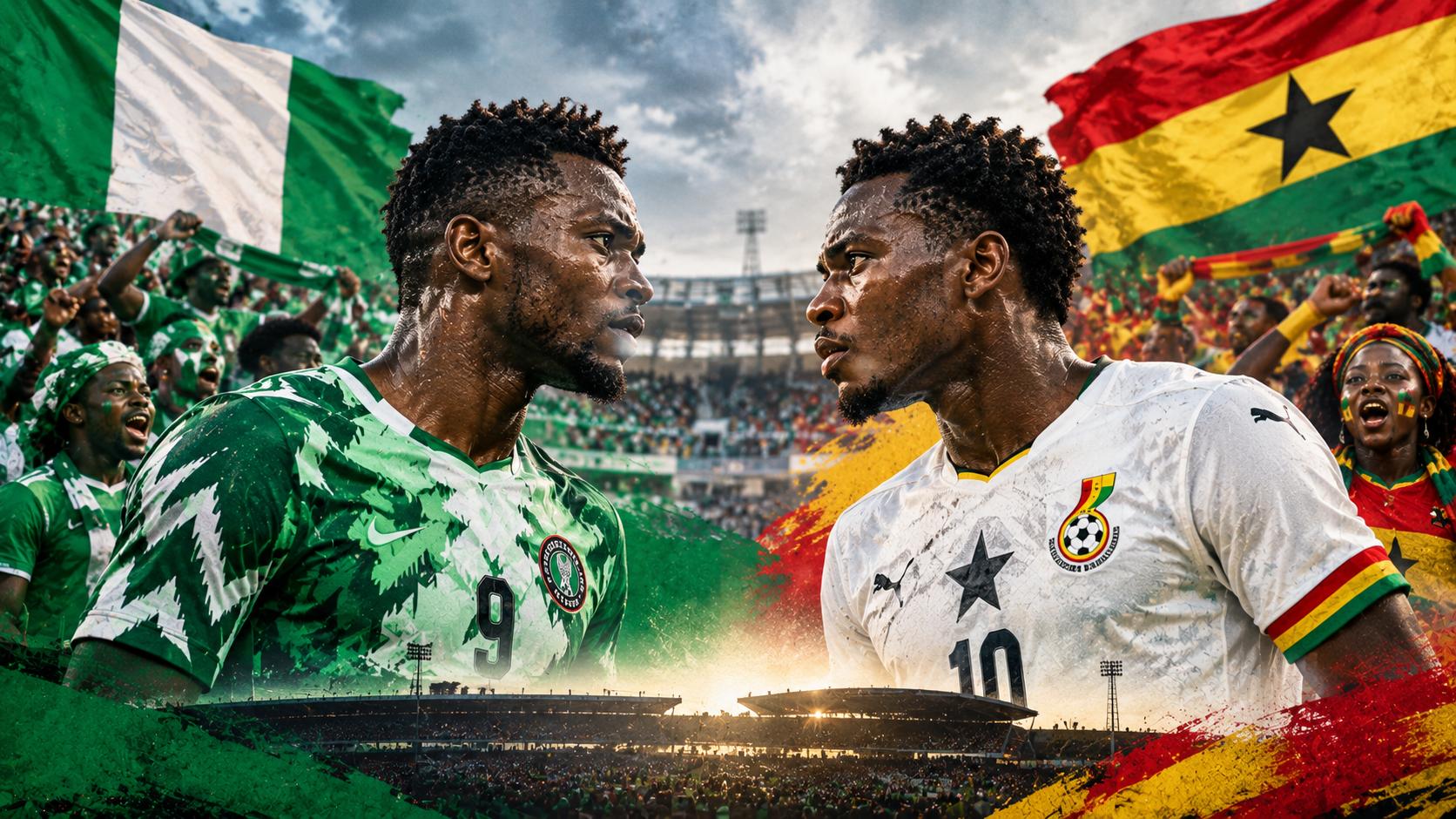
- The rivalry is nicknamed the Jollof Derby, after the long-running argument over which country makes the better jollof rice.
- The two sides first met on 16 October 1950, when Ghana, then the Gold Coast, won 1-0 in Accra.
- Ghana lead the overall record, and they have won three of the four AFCON knockout meetings between the sides.
- Ghana beat Nigeria in AFCON knockout games in 1992, 2008 and 2010, and went through on away goals in the 2022 World Cup playoff.
- Nigeria won the most recent meeting, 2-1 in the Unity Cup on 28 May 2025.
Why It Is Called the Jollof Derby
The name comes from the food. Jollof rice is a staple in both countries, and Nigerians and Ghanaians have argued for decades over whose version is better.
That banter spilled onto the pitch, and the fixture picked up its nickname from it. It is a lighter label than most rivalries carry, but the football has rarely been light. If you want to see how a fixture earns that kind of weight, our piece on what makes a football rivalry breaks down the ingredients.
Geography adds to it. The two countries sit a short distance apart on the West African coast, so most fans know someone on the other side.
How the Rivalry Began: The Jalco Cup Years
Long before the Jollof Derby had a name, the two sides were meeting in regional cups in the 1950s and 1960s, such as the Jalco Cup, the Nkrumah Cup and the Azikiwe Cup. FIFA’s official records treat 1960 as the start of the competitive rivalry, with Ghana winning a 1962 World Cup qualifier 4-1 in Accra on 27 August 1960, but the sides had been playing each other for a decade by then.
- 1951, Lagos: Nigeria beat the Gold Coast 5-0 in the Jalco Cup. Peter Anieke, Cyril Asoluka (twice), Titus Okere and Friday Okoh scored, in front of about 8,000 spectators. It remains Ghana’s heaviest defeat to an African opponent.
- 1955, Accra: Ghana answered with a 7-0 win in front of about 25,000 people. C. K. Gyamfi scored a hat-trick, Baba Yara added two, and Oscar Gespar and James Adjei got the others. Ghana led 6-0 at half-time. Before the game, Nigerian players Peter Anieke and Gowin Ironkwe asked for bonus payments and were suspended by the Nigerian FA, and claims of bribery were made but never proved. This is still Nigeria’s heaviest defeat on record.
- 1958, Lagos: Nigeria won 3-2, showing that the 1955 result was not the start of a one-way series.
Across the three exclusive cup competitions of that era, the wins were split evenly at eight apiece, according to the available records.
The Head-to-Head Record
The first meeting was a friendly on 16 October 1950 in Accra, then part of the Gold Coast, which Ghana won 1-0. Since then the teams have met in friendlies, qualifiers and tournaments for more than seven decades.
Sources differ on the exact tally. The site 11v11 lists 57 games with 22 Ghana wins, 21 draws and 14 Nigeria wins, while other databases count a couple of extra meetings, and all of them put Ghana ahead.
The draws matter as much as the wins. More than a third of the games have finished level, which tells you how evenly matched the two squads usually are.
Home Advantage Has Mattered
Records from competitive matches show how rarely the home side loses this fixture.
| Venue type | Matches | Record | Last home defeat |
|---|---|---|---|
| Ghana at home | 23 | 16 wins, 6 draws, 1 loss | 15 December 2002 |
| Nigeria at home | 20 | 8 wins, 9 draws, 3 losses | 10 February 1973 |
Ghana’s only home defeat in the series came in a friendly in Accra on 15 December 2002, when Nigeria won 1-0. Nigeria’s last home loss was the abandoned 1973 game described below, which was awarded to Ghana.
AFCON Knockout Meetings at a Glance
The Africa Cup of Nations is where the rivalry has produced its biggest moments. Four times the two sides have met in the knockout rounds.
| Year | Stage | Result |
|---|---|---|
| 1992 | Semi-final | Ghana 2-1 Nigeria |
| 2002 | Quarter-final | Nigeria 1-0 Ghana |
| 2008 | Quarter-final | Ghana 2-1 Nigeria |
| 2010 | Semi-final | Ghana 1-0 Nigeria |
Ghana have the edge, three wins to one, and two of those wins came in successive tournaments. The 2008 quarter-final, played on 3 February, took place at a tournament Ghana were hosting, so Nigeria were up against the crowd as well as the opposition.
The 2002 result is Nigeria’s only knockout win in the fixture, which is why their fans still bring it up when the record is discussed.
Three Matches That Defined the Rivalry
1. AFCON 1992 Semi-Final in Dakar
Nigeria took the lead through Mutiu Adepoju in the 11th minute, but Abedi Pele levelled before half-time. Prince Polley scored the winner early in the second half, and Ghana won 2-1.
The night had a sting for the winners too. Pele was booked in the 40th minute, a card widely seen as harsh, and it ruled the captain out of the final. Ghana reached it without him and lost to Ivory Coast in a record-length penalty shoot-out.
2. AFCON 2010 Semi-Final in Luanda
Ghana had already knocked Nigeria out at the 2008 tournament, which they hosted, so the 2010 semi-final on 28 January carried some history. Asamoah Gyan scored a near-post header in the 21st minute from a Kwadwo Asamoah corner.
Nigeria had chances, and Obafemi Martins missed a couple of good ones, including an air shot on the hour. It stayed 1-0, and Ghana went on to the final, where they lost to Egypt.
3. The 2022 World Cup Playoff
The 2022 tie was a two-legged playoff for a place in Qatar. The first leg in Kumasi on 25 March finished 0-0, so everything turned on the second leg in Abuja.
Partey’s early goal and Troost-Ekong’s penalty left the aggregate score at 1-1, and Ghana progressed on away goals. Nigeria pushed hard in the second half at home but could not find a winner. For Nigerian fans it stung because a World Cup place was on the line.
More Matches Worth Knowing
10 February 1973: The Abandoned World Cup Qualifier in Lagos
Few fixtures in African football have ended as badly. Ghana captain Malik Jabir’s comments at the airport angered Nigerian supporters before the 1974 World Cup qualifier, and Ghana scored a late winner to lead 3-2. Fans threw bottles, the match was abandoned, and the Ghanaian supporters’ bus was set on fire. Nigeria’s president sent an armoured vehicle to escort the players, and Ghana’s head of state provided a plane. FIFA awarded the game to Ghana 2-0, and the return leg in Accra finished 0-0.
28 July 2001: Nigeria 3-0 Ghana in Port Harcourt
Victor Agali scored in the second minute and Tijani Babangida added two more. Ghana goalkeeper Osei Boateng was sent off, and Emmanuel Osei Kuffour played in goal. The win took Nigeria to the 2002 World Cup.
3 February 2008: Ghana 2-1 Nigeria in Accra
Yakubu Aiyegbeni put Nigeria ahead with a 34th-minute penalty and Michael Essien equalised with a header before half-time. John Mensah was sent off for Ghana, but Junior Agogo scored the winner in the 82nd minute. The match was voted one of the best in the history of the Africa Cup of Nations.
6 February 2007: Ghana 4-1 Nigeria at Griffin Park
A friendly in west London turned into a Ghana rout. Laryea Kingston, Sulley Muntari, Junior Agogo and Joetex Asamoah Frimpong scored for Ghana, with Taye Taiwo replying for Nigeria. The kick-off was delayed by 35 minutes because of crowd problems.
28 May 2025: Nigeria 2-1 Ghana at Brentford
The most recent meeting came in the Unity Cup in London, and Nigeria won 2-1.
Off the Pitch: Migration, Politics and Pride
The rivalry has always been about more than football. Ghana’s Aliens Compliance Order in 1969 and a similar Nigerian law in 1983 led to mass expulsions of migrants between the two countries, and the memory of those years still feeds the tension. Chants of “Ghana must go,” a reference to the 1983 expulsions, were heard at the 2007 friendly in London.
Culture is the other layer. The two countries compete on music, film, status and food as much as football, and the jollof argument is the lightest-hearted version of that competition. Both countries also share an Anglophone heritage, which is why the comparisons are so constant.
Nigeria vs Ghana: The Honours Compared
| Honour | Nigeria | Ghana |
|---|---|---|
| Africa Cup of Nations titles | 3 (1980, 1994, 2013) | 4 |
| World Cup appearances | 6 | 5 |
| Best World Cup finish | Round of 16 (1994, 1998, 2014) | Quarter-finals (2010) |
| Olympic football gold | 1996 | None |
Nigeria lead on Olympic gold and World Cup appearances, while Ghana lead on Africa Cup of Nations titles, the head-to-head record and the best World Cup run. Our Super Eagles explainer has the full Nigerian honours list.
Players Who Defined the Rivalry
| Nigeria | Ghana |
|---|---|
| Mutiu Adepoju, Rashidi Yekini, Garba Lawal | Abedi Pele, Prince Polley, Asamoah Gyan |
| Jay-Jay Okocha, Nwankwo Kanu, Taribo West | Michael Essien, Sulley Muntari, Kwadwo Asamoah |
| Victor Agali, Tijani Babangida, Yakubu Aiyegbeni | Junior Agogo, Laryea Kingston, John Mensah |
| Ike Shorunmu, William Troost-Ekong | Baba Yara, C. K. Gyamfi, Thomas Partey |
For the Nigerian playmaker whose name comes up in every debate about the country’s best, see our profile of Jay-Jay Okocha.
Where the Rivalry Stands Today
The most recent meeting went Nigeria’s way. They beat Ghana 2-1 in the Unity Cup on 28 May 2025.
The bigger picture has since tilted towards Ghana. They qualified for the 2026 World Cup, their fifth appearance at the finals, while Nigeria missed out after losing a playoff to DR Congo on penalties.
Neither side can meet the other in AFCON 2027 qualifying, since the draw placed them in different groups. Nigeria are in Group L with Madagascar, Guinea-Bissau and Tanzania, and Ghana are in Group C with Ivory Coast, Gambia and Somalia. Our AFCON 2027 qualifiers guide lists all the groups and fixtures.
The next competitive meeting is more likely to come in the finals themselves. To understand where the Nigerian side of this rivalry gets its players, our guide to Nigeria’s football pyramid explains how grassroots talent reaches the national team.
Nigeria vs Ghana FAQ
Why is it called the Jollof Derby?
The name comes from the long-running argument over which country makes the better jollof rice. It is now used for any national team match between Nigeria and Ghana.
Who has won more, Nigeria or Ghana?
Ghana. Databases differ on the exact tally, but all of them put Ghana ahead, with a large share of draws.
When did Nigeria and Ghana first play?
On 16 October 1950, when the Gold Coast beat Nigeria 1-0 in Accra. FIFA’s official records start with a World Cup qualifier in 1960.
What is the biggest win in the fixture?
Ghana’s 7-0 win in 1955. Nigeria’s biggest win is the 5-0 victory in the 1951 Jalco Cup.
Has Nigeria ever beaten Ghana at the Africa Cup of Nations?
Yes. Nigeria won 2-1 in 1984 and 1-0 in a quarter-final in 2002, thanks to a late goal from Garba Lawal. Ghana have won all three other knockout meetings.
Who went to the 2022 World Cup, Nigeria or Ghana?
Ghana, on away goals after a 0-0 draw in Kumasi and a 1-1 draw in Abuja.
When did they last play?
Nigeria beat Ghana 2-1 in the Unity Cup at Brentford on 28 May 2025.
Which country has won more Africa Cup of Nations titles?
Ghana have four and Nigeria three, though Nigeria have the Olympic gold medal from 1996.
Why the Jollof Derby Deserves a Place Among Africa’s Big Fixtures
The Jollof Derby has a nickname built on rice and a record built on close games. Ghana lead the numbers and hold the most painful results, but Nigeria’s 2002 win and their 2025 win show the gap is never wide.
If you want to place it among the world’s best-known fixtures, our ranking of the biggest rivalries in football is a good comparison. Watch for the next meeting at a major tournament, because these two rarely play a dull one.