Offside means an attacking player is standing closer to the opponents’ goal line than both the ball and the second-last defender at the moment a teammate plays the ball forward to them, and the officials judge that player to be involved in the play. If that sentence already feels like a lot to take in during a live match, you are not alone.
Every fan who has groaned at a two-minute VAR check has wondered why football makes this so complicated. The actual rule is simpler than the drawn-out replays suggest, and once it clicks, it clicks for good.
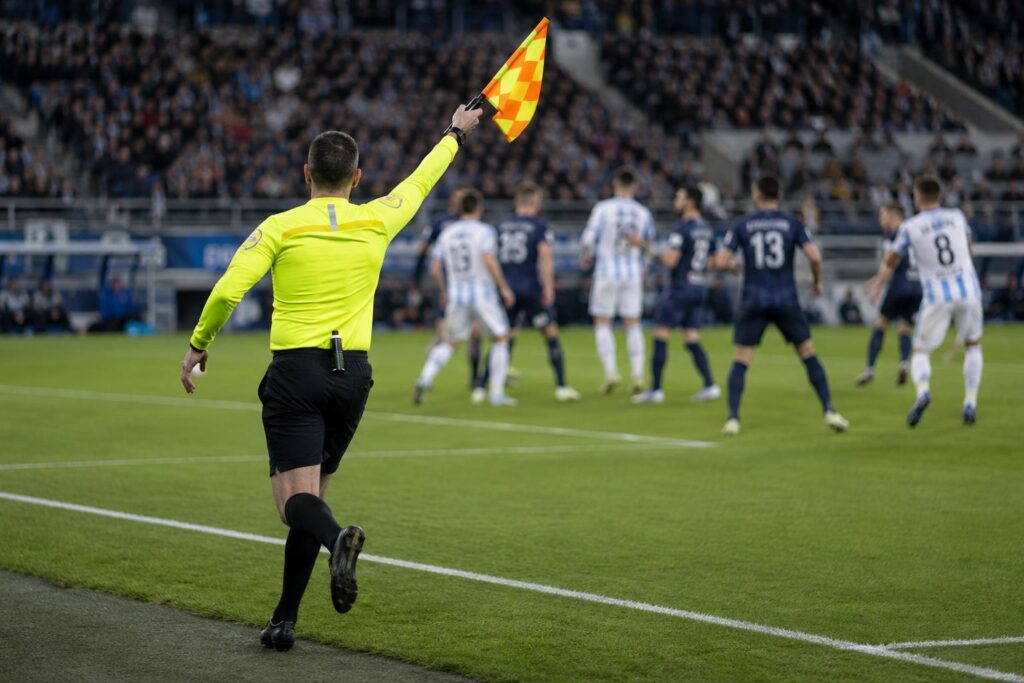
How Does the Offside Rule Actually Work?
Two separate things have to be true before a player is flagged. First, they need to be standing in an offside position the instant the ball is played. Second, they need to become involved in the passage of play that follows. Miss either condition and there is no offense, whatever the position on the pitch might suggest.
1. Being in an Offside Position
A player is in an offside position if any part of their head, body, or feet that can legally play the ball sits in the opponents’ half and is nearer to the goal line than both the ball and the second-last opponent. That second-last opponent is usually the last outfield defender, since the goalkeeper is normally the player closest to their own line.
2. Actually Committing the Offense
Standing in an offside position is not, by itself, against the rules. The player has to interfere with play by touching the ball, interfere with an opponent by blocking their run or their view, or gain an advantage by playing a ball that rebounds to them off a post, the crossbar, or a defender. A forward can be miles offside and do nothing wrong if the ball never reaches them and they stay out of the defender’s way.
3. When a Player Is Not Offside
A player level with the second-last defender is onside, not offside, because the law requires being nearer to the goal line, not level with it. A player can also never be offside directly from a goal kick, a throw-in, or a corner, and never offside while standing in their own half.
What Does an Offside Call Look Like in a Real Match?
It usually comes down to a single stride. Picture a striker timing a run in behind the last defender. At the instant the pass is played, the striker’s shoulder is level with that defender. A stride later, they have nudged half a yard ahead and finish into an empty net. That half-a-yard gap, frozen at the exact moment of the pass, is what gets argued over on every sports channel.
Since April 2025, the Premier League has used semi-automated offside technology to settle exactly these moments. A network of tracking cameras plots the position of the ball and every player’s limbs the instant a pass is struck, then generates the offside line automatically rather than leaving it to a linesman’s eye. It has not ended the arguments, but it has made the margins a lot harder to dispute.
What Do New Fans Usually Get Wrong About Offside?
A few myths about this rule stick around long after fans have watched hundreds of matches, mostly because the law rewards precision over intuition.
1. “Being Ahead of the Ball Means You Are Offside”
Being ahead of the ball is necessary but not enough on its own. A forward can be standing yards ahead of play in their own half and still be perfectly onside, since the offside line only applies once a player crosses into the opponents’ half.
2. “The Goalkeeper Always Counts as the Last Defender”
Usually true, but not guaranteed. The rule refers to the second-last opponent, whoever that happens to be. If a goalkeeper strays upfield or gets caught out of position, an outfield defender can become the relevant “last man” instead, and the offside line shifts with them.
3. “A Toenail Offside Should Not Count”
Under the letter of the law, it should. The rule measures any part of the body that can legally score a goal, which is why a striker’s toe or shoulder creeping a few centimeters beyond the last defender is enough to rule out an otherwise clean finish. It looks harsh on a big screen, but it is exactly what the law asks officials to check.
Reading the Offside Line Like a Regular
Offside will keep sparking arguments in pubs and living rooms, because the margin between a goal and a disallowed one is often smaller than a boot length. What changes once you understand the rule is how you watch it. Instead of waiting for a graphic to tell you the answer, you start spotting the moment a striker’s run gets timed right, or timed a fraction too early, before the officials even reach for a flag.
That is really the whole appeal of the rule. It rewards the striker who can judge a defensive line to the inch, and it punishes the one who cannot, and now you know exactly what the assistant referee is watching for every time.