England reached a World Cup semi-final for the first time since 2018, finished third for the first time since 1966, and produced one of the most chaotic and thrilling knockout campaigns in their tournament history. They also, once again, fell short of the final.
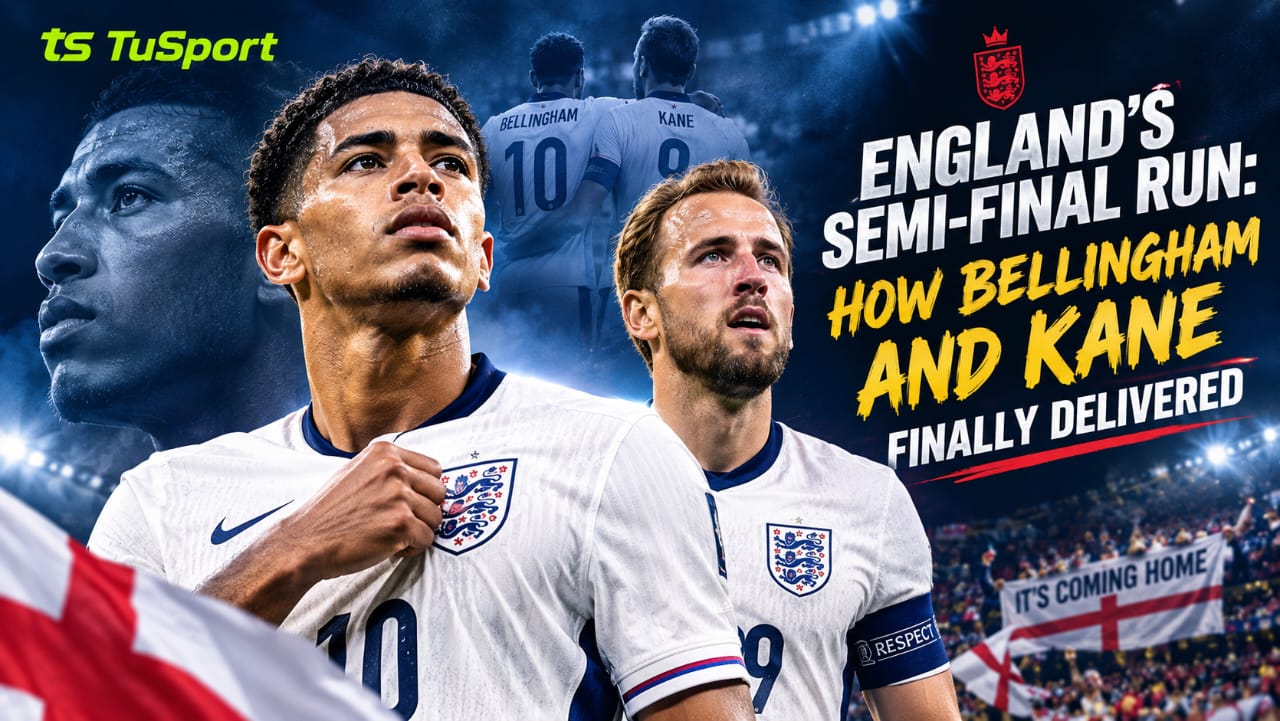
The story of England’s 2026 World Cup is ultimately the story of two men. Jude Bellingham, 23 years old and scoring goals that will be replayed for decades. Harry Kane, finally breaking every record England had left to offer him at a World Cup. And a team that gave everything except the one result that would have made it all worth it.
The Round of 16: Bellingham’s Azteca Double
England’s knockout run began at the Azteca in Mexico City on July 5, in what became one of the most memorable nights of the tournament.
Mexico led 1-0 at half-time when Bellingham produced a moment that changed the match and arguably the tournament. He headed in from Bukayo Saka’s cross to equalise, then almost immediately, straight from kick-off, Kane played him through to slot home a second. Two goals in 98 seconds: Bellingham became the first player since Diego Maradona to score twice in a World Cup game at that stadium in 40 years.
Kane added a penalty after Mexico keeper Raul Rangel brought down Anthony Gordon, making it 3-1 and putting England firmly in control. Mexico pulled one back through Jimenez’s penalty after a Kane foul was reviewed by VAR, and England finished the match with ten men after Jarell Quansah’s red card, but held on for a 3-2 win.
Kane’s penalty was his sixth goal of the tournament and broke Gary Lineker’s all-time England World Cup scoring record. He took his career tally to 11 goals across three tournaments, surpassing Lineker’s previous record of 10.
“It is a proud one for sure,” Kane told BBC Sport after the match. “I spoke before the tournament about the World Cup being the biggest competition we play as professional footballers, so to get to 11 goals is a proud feeling.”
Bellingham had four goals in total after the Mexico win and was named player of the match. Speaking in the mixed zone, he deflected credit toward his teammates: “I know what I can offer to the team but make no mistake about it, we’ve got 26 lads there who could’ve done exactly what I did tonight. I’m convinced of it.”
The Quarter-Final: Bellingham Does It Again in the Miami Heat
The quarter-final against Norway in Miami on July 11 was played in conditions that bordered on unacceptable. The temperature felt like 113 degrees Fahrenheit at kickoff, with 88 on the Wet Globe Bulb temperature measure, above FIFPRO’s recommended threshold of 82 for suspending or delaying matches.
Norway went ahead through Andreas Schjelderup’s 36th-minute cross-shot that deceived Jordan Pickford into his far post. England were rattled. Haaland, playing against the country of his birth, had a header saved by Pickford before the opener.
Bellingham rescued England once more. Collecting Anthony Gordon’s pass, he burst into the box and finished back across goal on his weaker left foot, levelling just before half-time. Kane had the ball in the net moments later but was flagged offside.
Norway dominated the second half and had a goal disallowed after VAR penalised Haaland for a foul on Elliot Anderson before the ball crossed the line. Kristoffer Ajer hit the crossbar in the 76th minute. England were hanging on.
The winner came three minutes into extra time. Substitute Morgan Rogers drove a shot from outside the area that goalkeeper Orjan Nyland could only push into a central position. Bellingham pounced and scored.
His sixth goal of the tournament made him the third-highest England World Cup scorer of all time, one ahead of Sir Geoff Hurst. He had also tied Gary Lineker and Kane’s record of six goals in a single World Cup, becoming the first Englishman with two multi-goal returns in a single World Cup knockout stage. Haaland, who had scored in his last 14 consecutive competitive games for Norway before this match, was withdrawn at halftime of extra time with nothing left to give.
Tuchel was blunt in his post-match assessment. “We made life very, very difficult for ourselves today. The result is fantastic but I’m not happy with the performance. We were sloppy, a lot of technical mistakes, not fast enough. We were lucky today.”
The Semi-Final: Argentina’s Stoppage-Time Heartbreak
England’s World Cup ended in Atlanta on July 16, in a manner that will haunt Tuchel’s tenure.
Anthony Gordon put England ahead in the second half. They led 1-0 with five minutes of normal time remaining. They were 90 seconds from their first World Cup final since 1966.
Then Argentina, with Lionel Messi still pulling strings and playing a fixture that has specialised in late heartbreak for six decades, produced one of the great tournament comebacks. Enzo Fernandez levelled in the 85th minute with a long-range strike. Lautaro Martinez headed in a Messi cross in the 92nd minute. Argentina had scored twice in seven minutes to win 2-1.
Tuchel’s defensive substitutions in the closing stages were immediately scrutinised. The changes altered England’s shape and allowed Argentina to take control precisely when England needed to hold firm. Kane later acknowledged that holding on had not been enough. The players were exhausted, carrying injuries from the Norway match in the Florida heat just five days earlier.
Crucially, Bukayo Saka, who had been outstanding in the tournament, was an unused substitute against Argentina. He only emerged to reveal this frustration days later.
The Third-Place Match: Saka’s Hat-Trick in the Wildest Game
England’s third-place match against France in Miami on July 19 produced one of the most extraordinary games in recent World Cup history.
They were 4-0 up at half-time through Declan Rice’s opener, Ezri Konsa’s header, and a Saka double, with France barely trying in a match that had already cost them their manager. The second half almost became one of the great collapses in England history as France, suddenly awake, pulled back to 4-3 through Mbappe’s double, the second of which made him the all-time World Cup leading scorer with 22 goals, and Barcola’s strike.
Saka’s penalty in the 87th minute restored England’s two-goal lead before Dembele’s 96th-minute strike for France threatened another twist. Then Bellingham drove into the area and finished from close range in the 98th minute to seal a 6-4 win, his seventh goal of the tournament, the most by an England player at a major tournament in history.
Saka became only the fourth Englishman ever to score a World Cup hat-trick. His omission against Argentina made the performance feel both triumphant and painful in equal measure. “I would love to have played more,” he told BBC Sport. “But it’s not the time to talk about that. I try to do my talking on the pitch.”
Tuchel, whose name was booed by England fans before kick-off, responded to the criticism plainly: “It is the first medal in 60 years, the best World Cup on foreign soil. I hope the players can be proud of that in some time.”
Why It Was Not Enough
England reached their fourth World Cup semi-final and finished third for the first time since winning the tournament in 1966. Bellingham scored seven goals, Kane broke the all-time England record, and Saka delivered the performance of his life in a match that came too late to matter.
What ultimately held England back was the same thing that has held them back across the past decade: the inability to manage a lead against elite opposition in the moments that count most. Leading Argentina with five minutes remaining and losing is the defining image of everything England’s 2026 World Cup was and was not.
The talent was there. The results, until the one that mattered most, were there. The final was not.
Follow TuSportNews for daily post-tournament analysis, player profiles, and the latest football news.