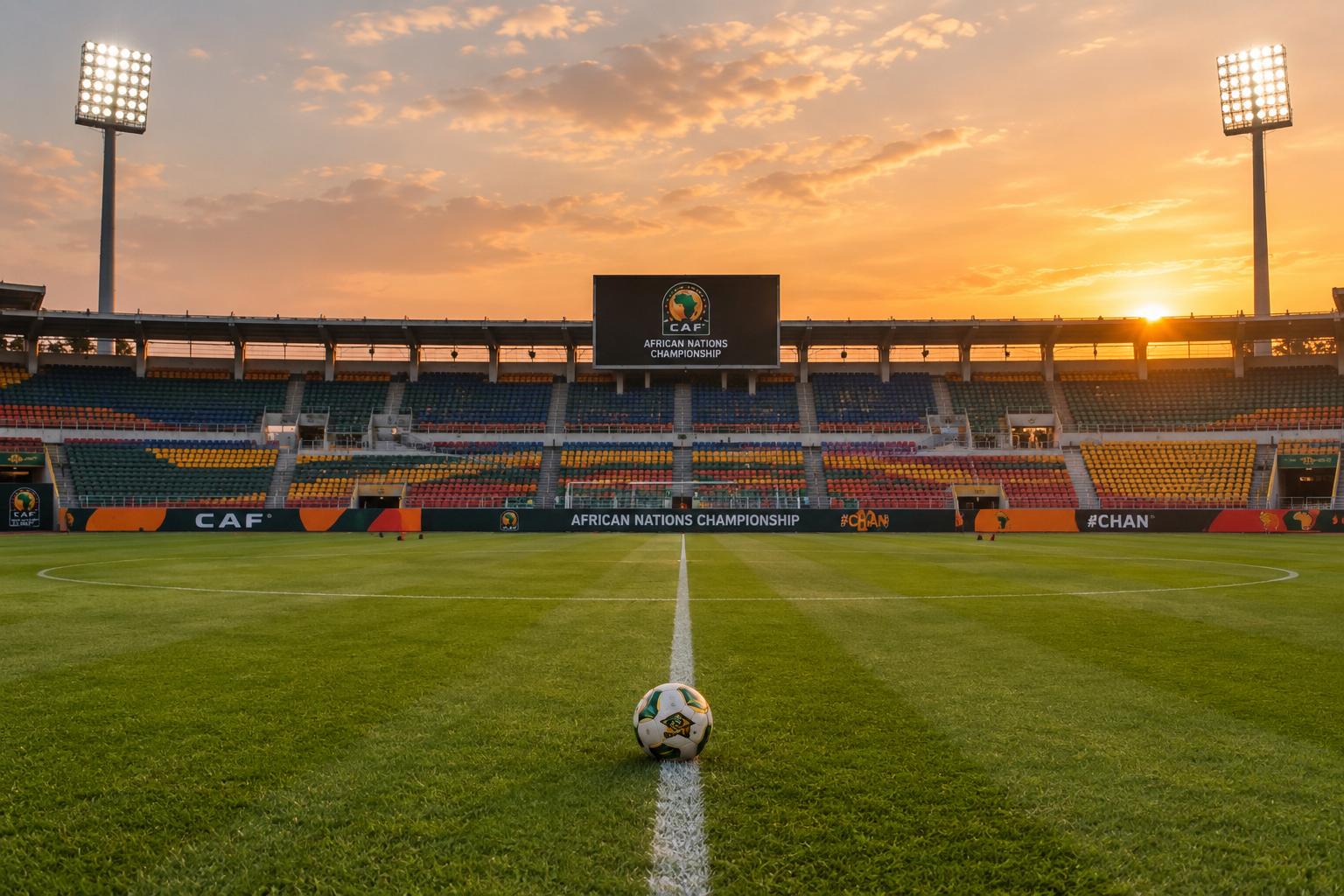
For 17 years, CHAN answered a question AFCON never really could: who is the best team built entirely from players plying their trade at home? That question no longer has a tournament attached to it. CAF confirmed in December 2025 that the African Nations Championship is being discontinued, closing out one of African football’s more distinctive competitions after its 2024 edition turned out to be its last.
Key Takeaways
- CHAN, the African Nations Championship, was restricted to players competing in their own country’s domestic league, unlike AFCON, which is open to every professional regardless of where they play.
- Founded in 2007 and first held in 2009, CHAN ran as a biennial tournament for 17 years.
- CAF President Patrice Motsepe confirmed in December 2025 that CHAN is being discontinued, citing heavy financial losses and a scheduling clash with the new African Nations League.
- The 2024 edition, co-hosted by Kenya, Uganda and Tanzania, turned out to be CHAN’s last. Morocco won it, their third CHAN title, beating Madagascar 3-2 in the final at Kasarani Stadium in Nairobi.
- CHAN is being replaced by the African Nations League, an annual senior-team competition launching in 2029.
What Made CHAN Different From AFCON
CHAN’s entire identity rested on one rule: eligibility was limited to players registered with clubs in their own country’s top domestic league. A Cameroonian playing for a French club could not turn out for Cameroon at CHAN, no matter how good he was. That single restriction is what separated it from AFCON, which selects from the full pool of a nation’s eligible professionals, wherever in the world they are based.
The idea behind that rule was straightforward. CAF wanted a tournament that rewarded strong domestic leagues and gave home-based players, coaches, and even the leagues themselves a continental stage that European-based stars would otherwise dominate at AFCON. For federations with strong local leagues, CHAN was a genuine showcase. For others, it exposed exactly how thin domestic talent pools had become compared to their export pipeline.
A Short but Eventful History
CAF founded CHAN in 2007, and the first edition kicked off in 2009 in Ivory Coast. It settled into a biennial rhythm from there, alternating years with AFCON so the continental football calendar had a senior national-team tournament every year rather than every two.
Morocco emerged as the competition’s dominant nation, winning the title three times across its history, in 2009, 2020, and again in its final edition. That third title came at the most recent CHAN, co-hosted jointly by Kenya, Uganda and Tanzania, the same three countries now preparing to host AFCON 2027. Morocco beat Madagascar 3-2 in the final at Kasarani Stadium in Nairobi to close out the tournament’s history on a high note for them, even as it turned out to be the competition’s last edition.
Hosting CHAN was never cheap, and the 2024 edition made that especially clear. Kenya, Uganda and Tanzania paid a combined figure of roughly USD 12.8 million in fees to CAF to co-host, a cost that, in hindsight, sits uneasily against Motsepe’s later description of the tournament as a financial drain.
Why CAF Decided to End It
CAF President Patrice Motsepe laid out two reasons for discontinuing CHAN at a December 2025 announcement in Rabat, Morocco. First, the tournament had become what he described as a consistent money loser for the confederation. Second, and more structurally, the newly announced African Nations League leaves no real calendar space for CHAN to keep running alongside it.
That second point ties into a bigger shift in how CAF is restructuring its entire competition calendar. AFCON itself is moving from a two-year cycle to a four-year cycle starting after the 2028 edition, which means AFCON 2027 will be the last tournament played under the old rhythm. That change opens a gap in years without a flagship men’s national-team tournament, and CAF’s answer to filling it is the African Nations League rather than reviving CHAN.
What Replaces It: The African Nations League
The African Nations League splits CAF’s 54 member associations into four geographic zones, North Africa, East Africa, West Africa, and Central and Southern Africa, with regional group-stage matches played during September and October international windows. The four zone winners then meet in a finals tournament each November.
Unlike CHAN, the African Nations League has no restriction on where players are based. It is built as a full senior national-team competition, open to every eligible player regardless of club, and is set to launch after the 2029 Club World Cup. In effect, CAF has traded a niche, domestically-focused tournament for one designed to keep every member federation playing competitive continental football every single year.
What CHAN’s End Means for African Football
CHAN’s disappearance is a genuine loss for the storyline it used to tell. It was one of the only stages where a strong domestic league translated directly into international success, and where a player who never left home could still become a continental hero. Its absence puts more pressure on federations to demonstrate the strength of home-based football through other means, since the tournament built specifically to showcase it no longer exists.
For fans following the three nations who hosted CHAN’s final edition, there is at least some continuity ahead. Kenya, Tanzania and Uganda are gearing up for an even bigger assignment next year, co-hosting AFCON 2027. Our complete guide to AFCON 2027 covers everything about that tournament, and our full 2027 African football calendar rounds up everything else happening across the continent as CAF’s competition structure continues to shift.