Spain just won the World Cup conceding one goal across eight matches. Their coach called them “absolutely unyielding.” Their two most influential players, Lamine Yamal and Pau Cubarsi, are both 19 years old. Rodri, the best midfielder in the world, will be 33 at the next tournament.
The rest of the world has four years to find an answer. Here is our verdict on who has the best chance of providing one.
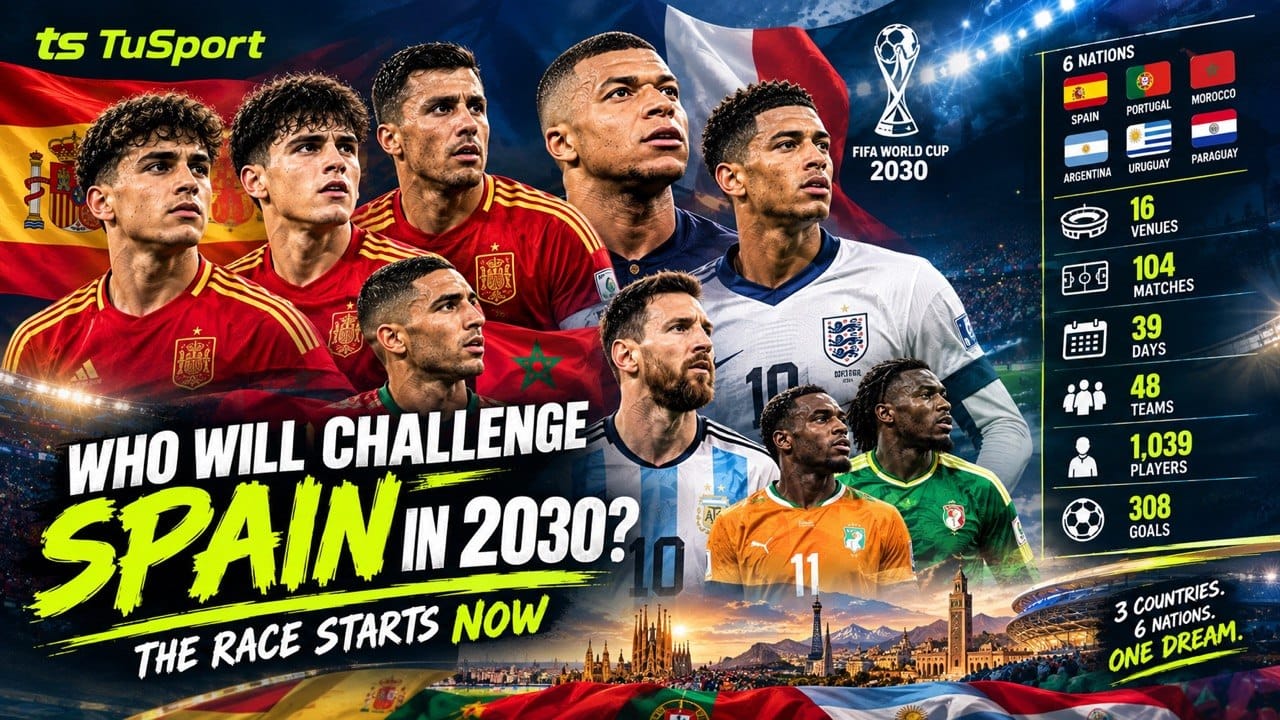
Why 2030 Is Different From Every World Cup That Came Before It
Before the rankings, context matters. The 2030 World Cup is not a normal edition. It will be co-hosted by Spain, Portugal, and Morocco, with centenary celebrations including matches in Argentina, Uruguay, and Paraguay. Three of the most credible challengers to Spain’s crown, Morocco, Portugal, and Argentina, will have the distinct psychological advantage of playing on home soil for part of the tournament.
As FIFA confirmed in their post-2026 analysis, Morocco and Spain were among the ten teams with the youngest average squad age in North America. The Atlas Lions’ performances proved they are no flash in the pan. Spain’s coach Luis de la Fuente made his intentions plain: “This team is absolutely unyielding.” The challenge for every nation below is not just to find quality. It is to find the kind of structural consistency that Spain have built across a decade of youth investment.
With that in mind, here is where the real race stands.
1. Spain: The Team Everyone Must Beat
Let us state the obvious first. Spain are not just defending a trophy. They are defending a system, and systems are far harder to dismantle than squads.
By 2030, Lamine Yamal will be 22 and Pau Cubarsi 23. Both will be entering the absolute prime of careers that have already produced a European Championship and a World Cup before either turned 20. The goalkeeping group of Unai Simon, Joan Garcia, and David Raya remains one of the deepest in Europe. Rodri, at 33, may be slightly less dynamic but has already demonstrated an ability to influence matches through intelligence rather than energy alone.
The risk for Spain is the one that comes for every champion: the hunger that drove them here. They have won the Nations League, Euro 2024, and the 2026 World Cup. Retaining the edge that produced a one-goal-conceded tournament while playing on home soil is a different psychological challenge from arriving as the underdog with a point to prove. History suggests home tournaments produce pressure rather than comfort, and Spain will need to manage that carefully.
They remain favourites. But they are beatable, and four years of opponents studying their system will produce answers that no team found in North America.
2. France: The Transition That Could Either Liberate or Fracture Them
France finished the 2026 World Cup with 20 goals, the joint-most of any team, and Kylian Mbappe holding the all-time World Cup scoring record with 22. They also lost both their semi-final and their bronze medal match, and finished a tournament in which their individual quality was never in question but their collective identity remained unresolved under Didier Deschamps.
Now Zinedine Zidane takes over. That change is potentially the most significant coaching appointment anywhere in world football for the next cycle. France’s squad problems have rarely been about talent. They have been about structure, ego management, and building a system that does not collapse when individual stars are neutralised. Zidane’s record at Real Madrid suggests he has those qualities, though managing a club and managing an international squad across a four-year cycle are very different challenges.
Mbappe will be 31 at the 2030 World Cup, still likely in the form of his life given his trajectory. Michael Olise, who broke Pele’s single-tournament assists record with seven in 2026, will be 28. Desire Doue will be 24. If Zidane can find the tactical coherence that Deschamps never quite managed, France’s individual quality alone makes them credible title contenders. The question is whether a new coach and a squad that has come close but never quite delivered the consistency of champions can make that final step.
3. England: The Generation That Has One More Chance
England finished third at the 2026 World Cup, their best result in 60 years. Jude Bellingham scored seven goals and Harry Kane broke the all-time England scoring record on the run to the semi-final. Bukayo Saka scored a hat-trick in the third-place match as an unused substitute against Argentina days earlier.
The frustration is inseparable from the achievement. England led Argentina with five minutes of normal time remaining in the semi-final. They were 90 seconds from their first World Cup final since 1966. Then Enzo Fernandez struck from distance in the 85th minute and Lautaro Martinez headed home in the 92nd.
By 2030, Bellingham will be 26, Saka 28, and Anthony Gordon 29, all approaching or in the absolute peak of their careers. Kane will be 36, the biggest question mark in an otherwise enviably gifted squad. England’s depth beyond their established core, including players who did not even make Tuchel’s squad, suggests the pool is not about to dry up.
What England needs is not more talent. It is the psychological breakthrough of finally winning a major tournament, which Euro 2028, hosted on home soil, could provide before 2030. If England arrive at the next World Cup as European champions, the conversation around their ceiling changes completely.
4. Morocco: Home Advantage and a Generation Coming of Age
Morocco’s story at the 2026 World Cup was one of the tournament’s defining narratives. They eliminated the Netherlands on penalties in the Round of 32, becoming the third African nation after Nigeria and Ghana to reach knockout stages in consecutive World Cups. They did it with a squad built on technical discipline, collective pressing, and a depth of talent drawn from the large Moroccan communities across France, Spain, the Netherlands, and Belgium.
In 2030, they are co-hosts. Achraf Hakimi will be 31, still arguably the most complete full-back on the planet. Ayyoub Bouaddi, the teenage midfielder who controlled tempo against the Netherlands and Brazil at this tournament, will be 22. Ismael Saibari, who scored the decisive penalty against the Dutch, will be 29. The U-20 World Cup generation, led by forwards Othmane Maamma and Yassir Zabiri, will be entering their mid-twenties.
Home advantage at a World Cup is not just a cliche. Morocco have already beaten Portugal, Spain, and now the Netherlands on the biggest stages. Playing on home soil, before their own supporters, in a tournament they know they will never be better positioned to win, makes them one of the most compelling stories of the next four years.
5. Argentina: Rebuilding Without a Blueprint
Argentina were the tournament’s most scrutinised side after the final. They reached it without Messi being able to impose himself the way he had in every previous round. Enzo Fernandez was sent off. Argentina became the first team in World Cup final history to fail to register a shot on target in normal time.
What comes next is genuinely uncertain. Lionel Scaloni tearfully acknowledged after the match that continuing felt “complicated.” Messi’s own international future remains unspoken. Removing the player who has defined this squad’s identity, tactical approach, and emotional core for eight years is not a transition. It is a rebuild.
What Argentina do have is depth beyond Messi that the final did not fully showcase. Julian Alvarez will be 30 at the 2030 tournament. Lautaro Martinez, who scored the winning goal against England, will be 32. Enzo Fernandez, who has significant amends to make after his red card, will be 33. The U-20 generation including Milton Delgado, Julio Soler, and goalkeeper Santino Barbi provides a foundation for renewal.
Home advantage across the centenary matches could allow Argentina to paper over the cracks of transition in ways that a neutral-venue tournament would not.
6. The African Wave: Ivory Coast, Senegal, and the Continent’s Rising Tide
The 2026 World Cup was African football’s most significant tournament. Morocco sent the Netherlands home. Cape Verde became the smallest nation ever to reach the knockout stage. Senegal’s Ismaila Sarr finished in the top ten scorers. Ivory Coast, with the youngest average squad age of any team in Group E, beat Ecuador and Curacao before falling to Norway.
Ghana, Tunisia, and South Africa all fielded starting XIs with average ages under 27 in North America. The continent is producing squads, not just individuals.
Ivory Coast deserve particular attention. Amad Diallo will be 27 in 2030. Simon Adingra 28. Yan Diomande 23. Their coach Emerse Fae has built something that looks increasingly like a project rather than a squad. Senegal and Egypt, controversy aside, also represent realistic contenders for deep knockout runs.
The 2022 semi-final was not Morocco’s ceiling. The 2026 knockout run was not the continent’s ceiling. The ceiling has not yet been found.
The Final Word: Spain to Win Again, But the Gap Is Closing
Four years is a long time in football. The 2018 World Cup favourites Germany went out in the group stage. The 2022 host Qatar became the first home nation to be eliminated in the group stage. The 2026 defending champions Argentina lost the final.
Spain have a system, a generation, and a coach. They also have a target on their back that every nation in this list is already aiming for. Mbappe, Bellingham, Hakimi, Bouaddi, Alvarez, Haaland at 29, and a wave of African talent still finding its level are all coming.
The 2026 World Cup produced 308 goals and the most statistically remarkable individual performances in the tournament’s history. The 2030 edition, played across three continents with six co-host nations and the deepest field ever assembled, promises to be even more extraordinary.
Spain conceded one goal to win it last time. To win it again, they will need to find that same standard. Everything in this ranking suggests they will not have it as easy as they did in North America.
The race starts now.
Follow for daily post-tournament analysis, player profiles, and the latest football news.