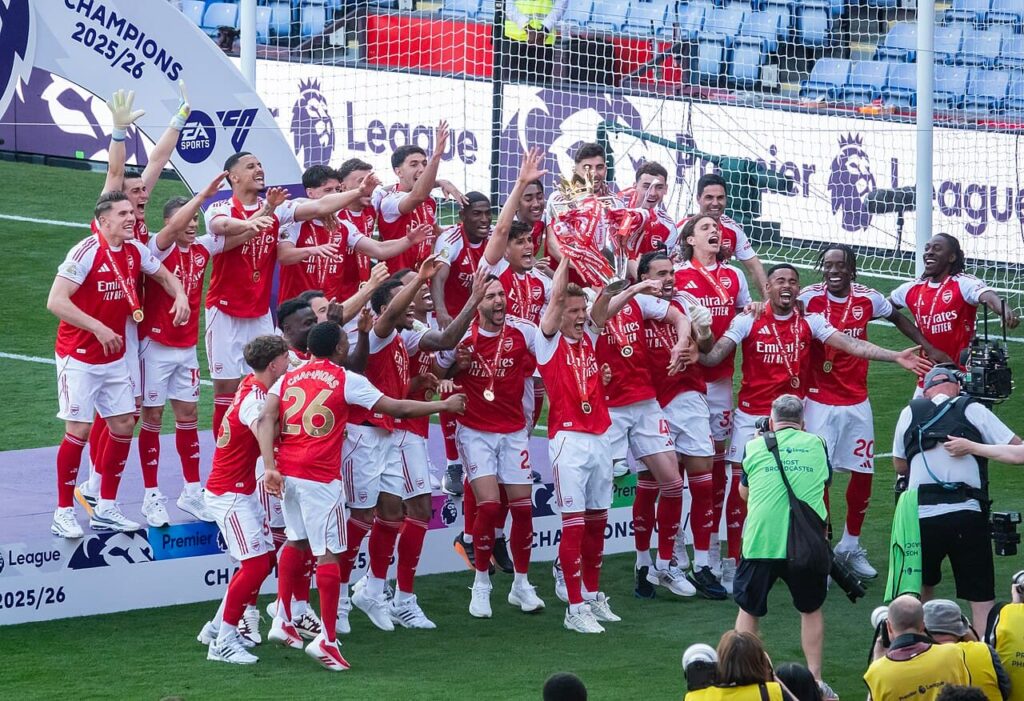
Arsenal waited 22 years for their fourth Premier League title, and when it arrived in May 2026 it came with 85 points, 7 clear of Manchester City. That one season shows most of what makes English football’s top flight so gripping: 20 clubs, 380 matches and a title race that was only settled in May. This guide gets the Premier League explained from the ground up, from the format and history to the champions and the 2026/27 season, and it works as a tidy reference for newcomers and long-time fans alike.
What Is the Premier League?
The Premier League is the top division of English football. It sits at the head of a pyramid that runs down through the EFL Championship, League One and League Two before reaching the non-league game.
It is also run differently from how most people expect. The 20 member clubs own the company that organises the competition, and each has a vote on how it operates. That company has existed since 27 May 1992.
The reach is enormous. Its matches are broadcast in more than 200 territories, which is why a mid-table fixture can draw viewers from Lagos to Kuala Lumpur. In total, 51 clubs have played in the competition, and only 6 have been present for every season since 1992: Arsenal, Chelsea, Everton, Liverpool, Manchester United and Tottenham Hotspur.
Here is the league at a glance:
| Detail | Premier League |
|---|---|
| Clubs | 20 |
| Matches per club | 38 |
| Matches per season | 380 |
| Points | 3 for a win, 1 for a draw, 0 for a defeat |
| Relegated each year | 3 |
| Season runs | August to May |
| First season | 1992/93 |
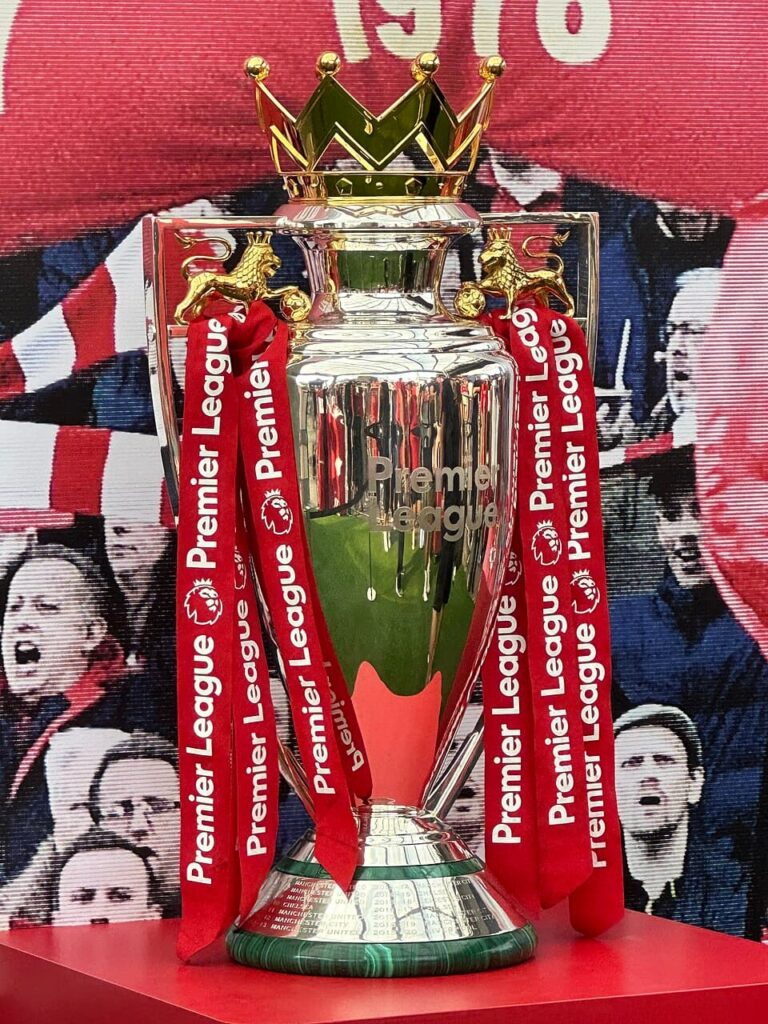
If you want live standings, club details and records in one place, the Premier League profile page is the quickest route.
How the Premier League Format Works
The format is simple enough to explain in a sentence: every club plays every other club twice, and the table after 38 matches decides everything. The details are where it gets interesting.
1. Points and Tiebreakers
Each club plays its 19 opponents once at home and once away. That gives 38 matches per club and 380 across the whole league. The maximum anyone can collect is 114 points, though the record is 100.
When clubs finish level on points, the tiebreakers are applied in this order:
- Goal difference, which is goals scored minus goals conceded.
- Goals scored.
- Points won in the matches between the tied clubs.
- Away goals scored in the matches between the tied clubs.
- A play-off on neutral ground, if everything else is identical.
During the season, clubs that are level on points, goal difference and goals scored simply share a position and are listed alphabetically. The head-to-head rules only come into play when final positions have to be settled. Goal difference has already decided a title once, in 2011/12, and that story is told in the history section below.
If those column headings still feel like code, you can read more in GD, GF and GA Explained: How to Read a Football League Table.
2. Promotion and Relegation
The bottom 3 clubs drop into the EFL Championship at the end of each season. Three clubs come up in their place: the top 2 from the Championship automatically, and a third through the play-offs. The Championship has 24 clubs, and the EFL Championship profile shows how that division is shaping up.
The margins can be tight. In 2025/26 West Ham finished 18th on 39 points and went down, while Tottenham stayed up in 17th on 41. Burnley (22 points) and Wolves (20 points, from 3 wins, 11 draws and 24 defeats) joined West Ham in the drop.
The most points ever collected by a relegated club in a 38-match season is 42, by West Ham in 2002/03.
The three promoted sides for 2026/27 each have a different story:
- Coventry City won the Championship and return for the first time since 2000/01. That 25-year absence is the longest of the Premier League era, and they are managed by Frank Lampard.
- Ipswich Town are back after just 1 year away.
- Hull City finished 6th, beat Middlesbrough in the play-off final and return after 9 years.
3. European Qualification
Finishing high also earns a place in Europe. The top 4 go into the UEFA Champions League. The next places go to the UEFA Europa League and the UEFA Conference League, and cup winners can add or shift spots.
For 2026/27, England also earned an extra Champions League place. UEFA confirmed that England ranked first in the 2025/26 association club coefficients, which earned it a European Performance Spot. Fifth-placed Liverpool took it.
Cup results then moved the other places around:
| 2025/26 Finish | Club | Route Into Europe |
|---|---|---|
| 1st | Arsenal | Champions League |
| 2nd | Manchester City | Champions League |
| 3rd | Manchester United | Champions League |
| 4th | Aston Villa | Champions League |
| 5th | Liverpool | Champions League, via the European Performance Spot |
| 6th | Bournemouth | Europa League, as the best-placed club not already qualified |
| 7th | Sunderland | Europa League, because City won the FA Cup and the place passed down |
| 8th | Brighton | Conference League, because City also won the EFL Cup and that place passed down |
The rule of thumb is that a cup winner takes the European place their trophy carries, and if they have already qualified through the league, the place drops to the next club in the table.
A Short History of the Premier League
The league is younger than many fans assume. 2026/27 is its 35th season, which means 34 have been completed.
1. The 1992 Breakaway
On 20 February 1992, the 22 clubs of the old First Division resigned from the Football League. The point was to run their own competition and to sell their television rights collectively. The Premier League became a company on 27 May 1992.
The first season kicked off on Saturday 15 August 1992 with 22 clubs. Brian Deane of Sheffield United scored the first goal, in a 2-1 win over Manchester United. The league shrank to 20 clubs from 1995/96, with 4 relegated and 2 promoted at the end of the previous season.
2. Who Has Won the Title
Seven clubs share the 34 titles so far:
| Club | Titles | Most Recent |
|---|---|---|
| Manchester United | 13 | 2012/13 |
| Manchester City | 8 | 2023/24 |
| Chelsea | 5 | 2016/17 |
| Arsenal | 4 | 2025/26 |
| Liverpool | 2 | 2024/25 |
| Blackburn Rovers | 1 | 1994/95 |
| Leicester City | 1 | 2015/16 |
United’s 13 were all won between 1992/93 and 2012/13, which means they took 13 of the first 21 titles. City then took over, winning 4 in a row from 2020/21 to 2023/24, a record. Liverpool ended a 30-year wait for a league title in 2019/20, and Arsenal ended a 22-year wait in 2025/26.
3. Seasons That Changed the League
A handful of campaigns stand out as turning points:
- Blackburn Rovers won the 1994/95 title, breaking up a run of two straight Manchester United wins.
- Arsenal’s 2003/04 side is the only one to go unbeaten through a Premier League season, and they finished 11 points clear of Chelsea.
- Manchester City won the 2011/12 title on goal difference, the closest finish possible with both clubs level on points, after Sergio Agüero scored in stoppage time on the final day.
- Leicester City won their only title in 2015/16, and it is widely seen as the league’s biggest surprise.
- City’s 2017/18 team collected 100 points, a record, and finished 19 clear of Manchester United.
The 2026/27 Season at a Glance
The current campaign began on Friday 21 August 2026, a week later than usual because of the World Cup, whose final was played on 19 July 2026. Arsenal opened at home to Coventry and won 3-0. The fixture list was released on 19 June 2026.
The calendar has a few dates worth circling:
| Date | What Happens |
|---|---|
| Friday 21 August 2026 | Opening night: Arsenal 3-0 Coventry City |
| Saturday 26 December 2026 | A fuller Boxing Day programme than last season |
| Sunday 30 May 2027 | Final day, with all 10 matches kicking off together at 16:00 |
Of the 38 rounds, 33 are weekend rounds and 5 are midweek. The midweek dates are 2 December and 30 December 2026, then 6 January, 10 February and 3 March 2027.
There are new faces in the dugouts too. Enzo Maresca replaced Pep Guardiola at Manchester City after a decade, Andoni Iraola took over from Arne Slot at Liverpool and Xabi Alonso is in charge at Chelsea.
The derbies will add their own drama. Several big derbies are still to come as scheduled: Liverpool v Manchester United on 21 November 2026, Everton v Liverpool on 28 November and Tottenham v Arsenal on 5 December. Broadcasters can move any of them, so treat those dates as provisional.
To see how any two clubs have fared against each other in recent seasons, including Liverpool and Manchester United or Tottenham and Arsenal, try our Premier League head-to-head tool.
If you want to understand why these games matter so much, read more in The Biggest Rivalry in Football: Ranking the World’s Fiercest Derbies.
How the Premier League Compares With Europe’s Other Big Leagues
The Premier League is one of five major European leagues, and they do not all work the same way. The main difference is size.
| League | Clubs | Matches per Club | Matches per Season |
|---|---|---|---|
| Premier League | 20 | 38 | 380 |
| La Liga | 20 | 38 | 380 |
| Serie A | 20 | 38 | 380 |
| Bundesliga | 18 | 34 | 306 |
| Ligue 1 | 18 | 34 | 306 |
Clubs in the Premier League, La Liga and Serie A play 4 more matches a season than their counterparts in Germany and France. That adds up to 74 extra matches per league, and it is one reason the English calendar feels so relentless through winter.
Premier League Records Worth Knowing
Records are a quick way to see how far the league has come in 34 seasons. These figures are accurate as of November 2026, though appearance counts change every week.
| Record | Holder | Figure |
|---|---|---|
| Most points in a season | Manchester City, 2017/18 | 100 |
| Fewest points in a season | Derby County, 2007/08 | 11 |
| Most goals by a club in a season | Manchester City, 2017/18 | 106 |
| Most goals by a player in a season | Erling Haaland, 2022/23 | 36 |
| Most career goals | Alan Shearer | 260 |
| Most career appearances | James Milner | 658 (to mid-October 2026) |
| Most career assists | Ryan Giggs | 162 |
| Biggest title-winning margin | Manchester City, 2017/18 | 19 points |
Haaland set his mark in 35 appearances. Portsmouth hold a less glamorous record of their own: they were docked 9 points for going into administration in 2009/10.
How to Follow the Premier League
You do not need to watch every match to keep up. A little routine goes a long way.
1. Watching Live
In the UK, the current rights deal runs from 2025/26 to 2028/29 and is worth £6.7bn. Sky Sports shows a minimum of 215 games, including Saturday 17:30 kick-offs, Sunday games and Friday and Monday evenings. TNT Sports has 52 games, mostly Saturday 12:30 kick-offs plus 2 midweek rounds.
The BBC shows highlights on Match of the Day.
One quirk surprises newcomers: the Saturday 3pm blackout. No Premier League match can be shown live on UK television between 14:45 and 17:15 on Saturdays.
UK clocks went back on Sunday 25 October 2026, so kick-off times are now in GMT. Rights holders differ by country, so check who has the league where you live.
2. Tracking the Table and Fixtures
Fixtures are fixed in June, but dates and times move once broadcasters pick their games, usually about 5 to 6 weeks before each round. Check the kick-off time a few days before you travel or set an alarm. A live table and fixture list are the best way to see how the title race, European places and relegation fight are shaping up week by week.
3. Following Fixtures and Results
Some fans like to check the schedule before kick-off. The Premier League profile lists fixtures and results for each round, and the leagues hub covers other leagues too.
Making the Most of the Premier League Season
With the Premier League explained from format to fixtures, the rest is simply following the story. Each season is 38 rounds, 380 matches and three races running at once: the title, the European places and survival.
Keep the basics in mind. A win is 3 points, a draw is 1, goal difference breaks ties and the bottom 3 go down. Everything else, from the rivalries to the records, builds on that.
The best part of the calendar comes at the very end. On Sunday 30 May 2027, all 10 matches kick off together, and whatever is still undecided gets settled at the same moment.