A yellow card is a formal caution for a foul, act of dissent, or piece of misconduct that falls short of a sending off, while a red card removes a player from the match entirely with no replacement allowed. Two yellow cards in the same game also add up to a red, since the second caution triggers an automatic sending off.
Both cards exist to give referees a graded way to punish misconduct, from a mistimed tackle worth a talking-to, up to conduct serious enough to end someone’s afternoon.
Key Takeaways
- A yellow card is a formal caution; a red card ends a player’s involvement in the match with no replacement allowed.
- Two yellow cards in one match automatically become a red card.
- Red cards typically carry an automatic one-match ban or longer, depending on the offense and competition.
- Denying an obvious goal-scoring opportunity (DOGSO) can turn what looks like a yellow-card foul into a red.
- VAR can intervene on clear and obvious red card errors, but rarely overturns yellow-card decisions.
What Is a Yellow Card in Football?
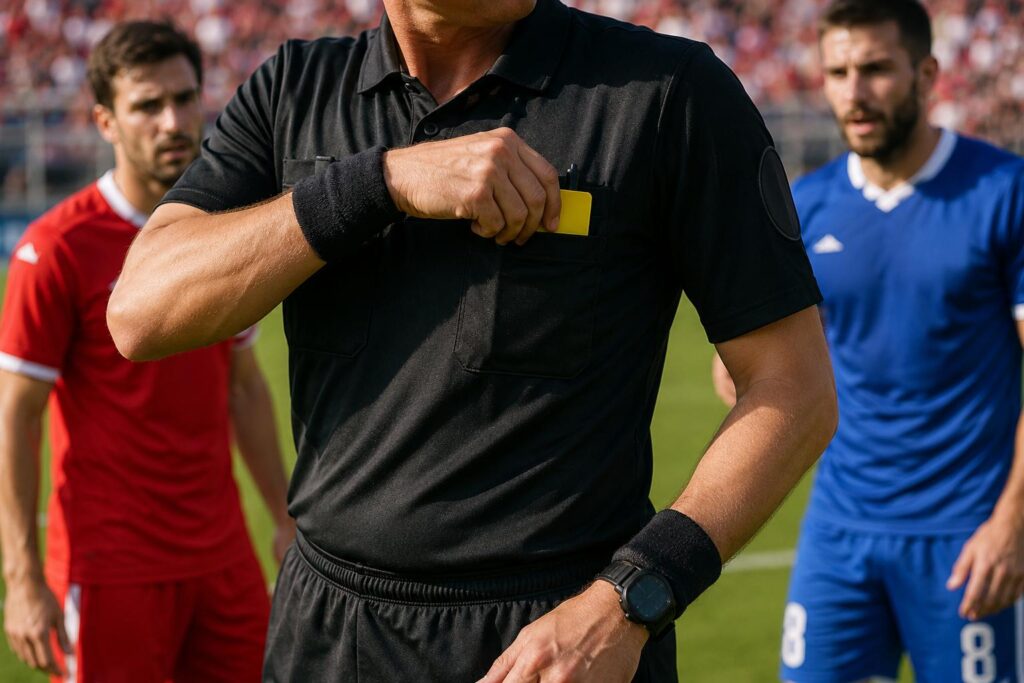
A yellow card is a caution shown for a specific list of offenses that IFAB’s Laws of the Game class as unsporting but not severe enough for an instant sending off. It goes into the referee’s notebook and stays on the player’s disciplinary record for that competition.
Common reasons a referee reaches for yellow include the following.
- A reckless tackle that endangers an opponent without excessive force.
- Persistent fouling across the course of a match.
- Dissent shown through words or actions toward a match official.
- Delaying the restart of play, including time-wasting near the end of a game.
- Failing to retreat the required distance at a free kick or corner.
What Is a Red Card in Football?
A red card sends a player off for the rest of the match, and their team continues with one fewer player for however long remains, since no substitute is permitted to replace them. It is reserved for offenses IFAB treats as serious enough to end a player’s involvement outright.
The clearest example is serious foul play or violent conduct, but a red card also follows denying an obvious goal-scoring opportunity through a foul or deliberate handball, spitting at anyone on the pitch, or using offensive or abusive language or gestures.
Yellow Card vs Red Card: The Key Differences
| Yellow Card | Red Card | |
|---|---|---|
| Meaning | Formal caution | Sent off, match over for that player |
| Effect on the team | None immediately | Plays a player short, no replacement |
| Common triggers | Reckless tackle, dissent, time-wasting | Violent conduct, serious foul play, denying a clear goal-scoring chance |
| Two in one game | Second yellow becomes a red automatically | Not applicable |
| Carries over | Accumulated yellows can trigger a ban after a set number | Almost always a ban, often multiple matches |
What Happens After a Red Card?
Once the referee shows red, the disciplinary process moves beyond that single match.
1. The Team Plays Short-Handed
The sent-off player cannot be replaced, so their side finishes the game with ten men, or fewer if a second red follows. Managers often reshuffle into a more defensive shape immediately to cope with the numerical disadvantage.
2. A Suspension Usually Follows
Red cards typically carry an automatic ban of at least one match, with more serious offenses like violent conduct drawing longer suspensions. The exact length depends on the competition’s own disciplinary code and, in some cases, a post-match review panel.
3. Yellow Cards Can Add Up Too
Most leagues and cup competitions ban a player once they collect a set number of yellow cards across a defined stretch of matches, even without ever picking up a straight red. The threshold and the matches it resets over vary by competition, so a player can serve an accumulation ban that has nothing to do with any single tackle.
Situations That Turn a Caution Into a Sending Off
A second yellow is the most familiar route to red, but it is not the only one worth knowing.
Denying an obvious goal-scoring opportunity, often shortened to DOGSO, escalates what might otherwise be a yellow-worthy foul into a red once the referee judges the attacker had a clear run at goal. A professional foul used purely to stop a breakaway is judged the same way. Grassroots football in some countries has also experimented with a blue-card sin-bin system for cynical fouls and dissent, though the concept has not been adopted at the professional level.
VAR and Red Card Decisions
Video assistant referees can intervene on red cards in a way they generally cannot for yellows, since a straight red is treated as a “clear and obvious error” the on-field referee is allowed to review on the pitch-side monitor. A soft yellow rarely gets overturned this way, but a missed serious foul, or a red shown for a challenge that turns out to be fair, both fall inside VAR’s remit to correct.
Knowing the Difference When It Matters
Once you can separate a caution from a sending off, a referee’s decision stops feeling arbitrary and starts looking like exactly what it is: a judgment call about how serious the offense was, made in real time and under pressure. The card itself is just the visible marker of that call.
Next time a player goes into the book, or walks straight down the tunnel, you will already know roughly why, and what it means for the ninety minutes still to come.
1 thought on “Red Card vs Yellow Card in Football: The Rules Explained”